 Ultimate guide
Making Worship Accessible for Neurodivergent People
Table of Contents
- Why Making Worship Accessible for Neurodivergent People Matters
- Sensory-Friendly Church Service Ideas That Work
- Accommodations for Neurodivergent Congregants: A Practical Checklist
- Inclusive Liturgy and Neurodiversity-Affirming Language
- Training Church Leadership and Volunteers for Inclusive Ministry
- Crisis and Meltdown Protocols: Creating Safe Spaces
- Digital and Hybrid Accessibility for Neurodivergent Worshippers
- Conclusion: Moving from Awareness to Implementation
- Frequently Asked Questions
Last Updated: October 2, 2026
Why Making Worship Accessible for Neurodivergent People Matters
Making worship accessible for neurodivergent people is the practice of removing sensory, cognitive, and social barriers so that autistic worshippers and others with different neurological processing can participate fully in congregational life. This work matters because churches that fail to address overstimulation and unclear expectations lose worshippers who want to be there.
Sensory-Friendly Church Service Ideas That Work
The most effective sensory-friendly church service ideas combine predictable structure, controllable sensory input, and a retreat space worshippers can access without asking permission. None require a building project.
Lighting, Sound, and Seating Adjustments
Start with what you already control. Swap flickering fluorescent tubes for warm, dimmable lighting. Lower the worship band's amplification and keep the mix consistent week to week, since sudden volume spikes cause more distress than sustained volume. Reserve back rows and aisle seats for people who need to move, stand, or leave quickly.
Quiet Spaces and Fidget Tools
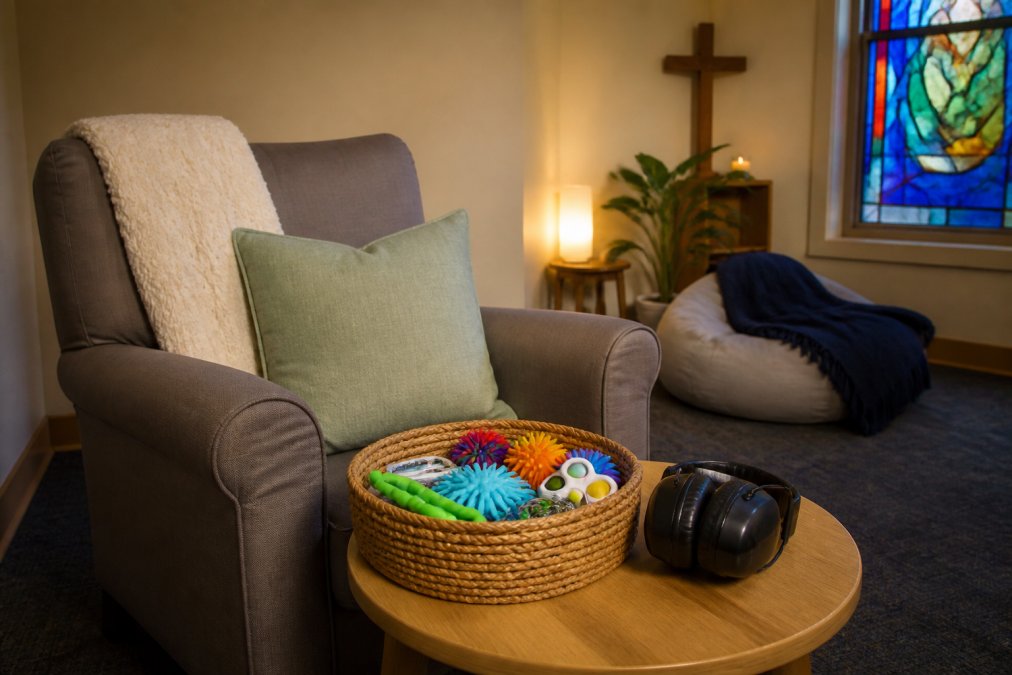
A quiet space is a room, alcove, or curtained corner where a worshipper can regulate without being followed or questioned. Stock it with fidget tools, noise-canceling headphones, weighted lap pads, and a visual schedule of the service. Location decides whether it gets used: if it sits at the end of a long corridor past three greeters, most people will never find it.
Accommodations for Neurodivergent Congregants: A Practical Checklist
Effective accommodations for neurodivergent congregants are specific, published in advance, and available every week, not on request. Use this checklist to audit your church environment:
- Service order published by Friday, including song titles and sermon topic
- Quiet space open and staffed from 15 minutes before the service
- Sensory kits available at the welcome desk (headphones, fidget tools, sunglasses)
- Visual schedule posted at the entrance and inside the quiet space
- One trained volunteer per service assigned as a sensory point of contact
- Advance notice of any change to lighting, sound levels, or liturgy
- Clear exit routes that don't cross the platform or the choir
Visual Schedules and Social Stories
A visual schedule shows the order of the service in words and simple images, so worshippers know what happens next without reading social cues in real time. Social stories go further: short plain-language narratives describing what to expect at a baptism, communion service, or potluck. Both reduce the cognitive load of an unfamiliar environment and take an afternoon to produce.
Noise-Canceling Headphones and Sensory Kits
Noise-canceling headphones and sensory kits turn an unpredictable room into a manageable one. Kits don't need to be expensive: a small bag with headphones, two or three fidget tools, a weighted item, and a printed schedule covers most needs. Keep the sign-out frictionless, if a worshipper has to fill in a form or explain why they need headphones, the kit will sit in the cupboard.
Inclusive Liturgy and Neurodiversity-Affirming Language
Inclusive liturgy is worship language and structure that assumes neurodivergent participation rather than treating it as an exception. Words shape belonging: phrases like "everyone stand" or "let us all sing loudly" quietly tell some worshippers they are doing it wrong. Try "stand if you're able," "join in however feels right for you," and "sing, hum, or simply listen." These edits cost nothing and change the room.
Liturgical Adaptations for Different Needs
Liturgical adaptations are changes to the order, pacing, or format of worship that widen participation without losing the tradition. Options that work across denominations:
| Adaptation | Best For | Effort |
|---|---|---|
| Printed order of service with page numbers | Cognitive accessibility | Low |
| Repeated refrain sung three times | Auditory processing differences | Low |
| Movement-free participation option | Motor and sensory needs | Low |
| Shortened spoken responses | Anxiety and processing time | Medium |
| Visual projection of all lyrics and readings | Reading and attention differences | Medium |
Training Church Leadership and Volunteers for Inclusive Ministry
Volunteer training is where inclusive ministry succeeds or collapses. A greeter who panics when a child flaps their hands undoes six months of good intentions, yet most churches stop at a single awareness talk and never build the repeatable training loop that changes Sunday behavior. The goal is not sympathy; it is competence.
What a Working Training Loop Looks Like
Treat training as a cycle, not an event. A pattern that holds up across small and mid-sized congregations:
- Baseline session (90 minutes, twice a year). Cover four competencies: recognizing sensory overload, responding during a meltdown or shutdown, offering help without hovering, and knowing where the quiet space is and how to escort someone there.
- Role-specific add-ons (30 minutes). Greeters need door scripts, sound techs a consistent mix, children's volunteers transition warnings, ushers exit-route fluency. One generic session does not fit all four roles.
- Scenario drills (15 minutes, quarterly). Walk through two or three real situations: a child covering their ears mid-sermon, an adult who goes silent and still during communion, a visitor who asks to leave through a side door. Rehearse the words, not just the concept.
- Debrief (10 minutes, monthly). Ask volunteers what they saw and what they wished they had known. This is where the protocol gets sharper.
Scripts Beat Sentiment
Volunteers freeze because they don't know what to say. Give them exact language:
- Greeting: "The quiet room is just inside the main doors on the left. You can come and go whenever you need to."
- Offering help: "Would you like headphones, a quieter seat, or some space? Any of those is fine."
- During overwhelm: "I'm going to stay right here with you. We can step out whenever you're ready. No one is watching."
- To a parent: "You don't need to explain anything. Tell me what helps and I'll make it happen."
Moving from Welcoming to Empowering
Most guides stop at making neurodivergent people comfortable in the pews. The deeper work is supporting them into active ministry: reading Scripture, running the sound board, leading a small group, serving on the welcome team, preaching. That requires three things:
- Ask, don't assume. Neurodivergent members are often never invited into roles because leaders assume they wouldn't want them. Ask directly, and ask more than once.
- Redesign the role, not the person. If a role requires rapid multitasking or loud environments, offer a variant that fits. A sound tech who can't handle stage volume can mix from a booth; a reader who struggles with long passages can take a shorter one.
- Name a point person. One staff or lay leader owns neuro-inclusion, tracks what is working, and reports to leadership each term. Without an owner, training fades within two quarters.
Measuring Whether It's Working
Track three signals: how many sensory kits were signed out, how many people used the quiet space, and whether any neurodivergent member took on a new role in the last six months. If all three are flat, the training isn't translating into practice. Adjust the loop, not the people.
Crisis and Meltdown Protocols: Creating Safe Spaces
A meltdown protocol is a written, rehearsed plan for when a worshipper becomes overwhelmed, and it belongs in your volunteer handbook. Most churches improvise in the moment, which is exactly when mistakes happen. Here is a concrete, step-by-step protocol you can adapt and print.
Meltdown vs. Shutdown vs. Overstimulation
These are nervous system events, not behavior problems, and they call for different responses.
- Overstimulation (early): fidgeting, covering ears, pacing, flushed face, short answers. Response: reduce input, offer the quiet space, do not crowd.
- Meltdown (escalated): crying, shouting, flailing, dropping to the floor, attempts to flee. Response: safety and space, minimal words, one familiar person.
- Shutdown (escalated): going silent and still, staring, unresponsive, curling inward. Response: the same as a meltdown, quiet presence, no demands, no touching without consent.
A Step-by-Step Protocol You Can Print
Assign roles in advance so no one decides in the moment.
- Spotter. The first volunteer who notices alerts the sensory point of contact quietly, by text or a pre-agreed signal, not by calling across the room.
- Point of contact. Approaches slowly, at eye level if possible, and uses a short script: "I'm here. We can step out whenever you're ready." No questions that require a verbal answer.
- Escort. Guides the person to the quiet space via the nearest exit, not across the platform or through the choir. Walk beside, not behind.
- Quiet space attendant. Stays nearby but does not hover. Offers water, headphones, a weighted item, or silence. Follows the person's lead.
- Family contact. If the person is a minor or arrived with someone, a designated volunteer notifies them discreetly. Never broadcast the event over a radio channel others can hear.
- Return or release. When the person is regulated, offer the choice to return, sit in the quiet space for the rest of the service, or leave. All three are valid.
The Quiet Space Itself
Location decides whether the space gets used. If it sits at the end of a long corridor past three greeters, most people will never find it. Put it near the main entrance, mark it clearly, and mention it in every welcome announcement. Stock it with fidget tools, noise-canceling headphones, weighted lap pads, water, tissues, and a printed visual schedule.
After the Event
Churches often handle the moment well and then never follow up. Within 48 hours, the point of contact should check in briefly, without interrogation, and ask two questions: "Did that feel safe?" and "What would have helped?" Write down the answers, review them at the next volunteer debrief, and update the protocol.
Digital and Hybrid Accessibility for Neurodivergent Worshippers
Digital accessibility extends belonging to worshippers who can't attend in person, and it's the angle most churches overlook. Livestream with consistent audio levels, publish captions, and post the full order of service online before Sunday. Moderate chat too: a fast-moving comment thread recreates the overstimulation of a crowded lobby.
Conclusion: Moving from Awareness to Implementation
The hardest part of this work isn't understanding it, it's starting when your building, budget, and calendar all feel stretched. Let Her Sing! is a compelling call to action for the church, inviting every voice to participate in the life and worship of the congregation. Our resources focus on community-based worship and advocacy for inclusive congregational singing, built for churches that want every voice in the room, not just the confident ones.
Frequently Asked Questions
How can churches better support neurodivergent members during worship?
Start by offering sensory-friendly options like quiet spaces, dimmable lighting, and noise-canceling headphones. Provide visual schedules and social stories so people know what to expect. Train volunteers to recognize signs of overstimulation and respond calmly. Simple changes like these make worship accessible for neurodivergent people without disrupting the service for others. Ask neurodivergent members what they need, since accommodations work best when they are tailored to actual experience.
What are simple sensory adjustments for neuro-inclusive church services?
Lower the volume on microphones and instruments, reduce bright or flashing lights, and designate a quiet room with soft seating. Offer fidget tools and noise-canceling headphones at the entrance. Print a visual schedule of the service order. Allow movement during worship rather than expecting everyone to sit still. These sensory-friendly church service ideas cost little and can be implemented gradually, making your church environment more welcoming for people with sensory processing differences.
How does neurodiversity impact the way people experience worship?
Neurodivergent individuals may process sound, light, and social cues differently. For someone with auditory processing differences, a loud worship band can feel painful. For others, unexpected changes in liturgy cause anxiety. Understanding these differences helps church leaders design worship experiences that include rather than exclude. When you make worship accessible for neurodivergent people, you acknowledge that congregational belonging means everyone can participate in their own way, whether that is singing, listening, or using fidget tools.
Are there specific liturgical changes that help neurodivergent congregants?
Yes. Keep the order of service consistent week to week. Announce transitions clearly before they happen. Offer a large-print or picture-based bulletin. Allow alternative participation, such as humming instead of singing or standing at the back. Some churches include a moment of silence for emotional regulation. These liturgical adaptations honor tradition while making room for different ways of engaging, which is central to inclusive liturgy and neurodiversity-affirming practice.
How can church leadership foster a culture of belonging for neurodivergent individuals?
Leadership sets the tone. Include neurodivergent people on planning teams and ask what they need. Train volunteers in disability theology and practical accommodations. Use inclusive language from the pulpit, avoiding metaphors that frame disability as something to be fixed. Celebrate different ways of participating, whether that is singing, signing, or simply being present. When leaders model curiosity and humility, the congregation follows, and worship becomes a place where every voice belongs.