 Ultimate guide
Community Worship Music Programs: A Practical Guide
Table of Contents
- Start with a Community Needs Assessment
- Build an Inclusive Church Choir That Welcomes Every Voice
- Define Church Music Ministry Roles Beyond the Stage
- Introducing New Worship Songs Without Losing the Congregation
- Worship Team Leadership: Serving the Community, Not the Performance
- Budget, Safeguarding, and Accessibility: The Foundations of Community Worship
- Measure What Matters: Outcomes and Sustainability for Community Worship
- Conclusion: Let Go and Let God Build Your Community Worship
- Frequently Asked Questions
Last Updated: October 18, 2026
Start with a Community Needs Assessment
Implementing community worship music programs begins with listening, not planning. Before you choose a single song or recruit a single singer, find out who is already in your pews and what musical gifts they carry.
A community needs assessment is a structured way of learning what your church already has. It is not a survey for its own sake. It is the foundation everything else rests on.
Here is a simple assessment you can run in four weeks:
- Inventory the gifts. List every member who sings, plays an instrument, reads music, or has led music elsewhere. Include the ones nobody has asked yet.
- Ask three questions. What music moves you closer to God? What keeps you from participating? What would you offer if you could?
- Map the gaps. Note which ages, languages, and abilities are missing from your current music life.
- Listen to the quiet voices. Talk to members who sit in the back row, the parents of children with disabilities, and the elderly who no longer sing.
Many churches find that the biggest barrier is not talent but invitation. People assume the stage is for professionals. A short conversation often reveals a lifelong musician who simply never been asked.
Write down what you learn. That document becomes the reference point for every decision that follows, from repertoire to rehearsal times.
Build an Inclusive Church Choir That Welcomes Every Voice
An inclusive church choir is one where the door is genuinely open, not just politely ajar.
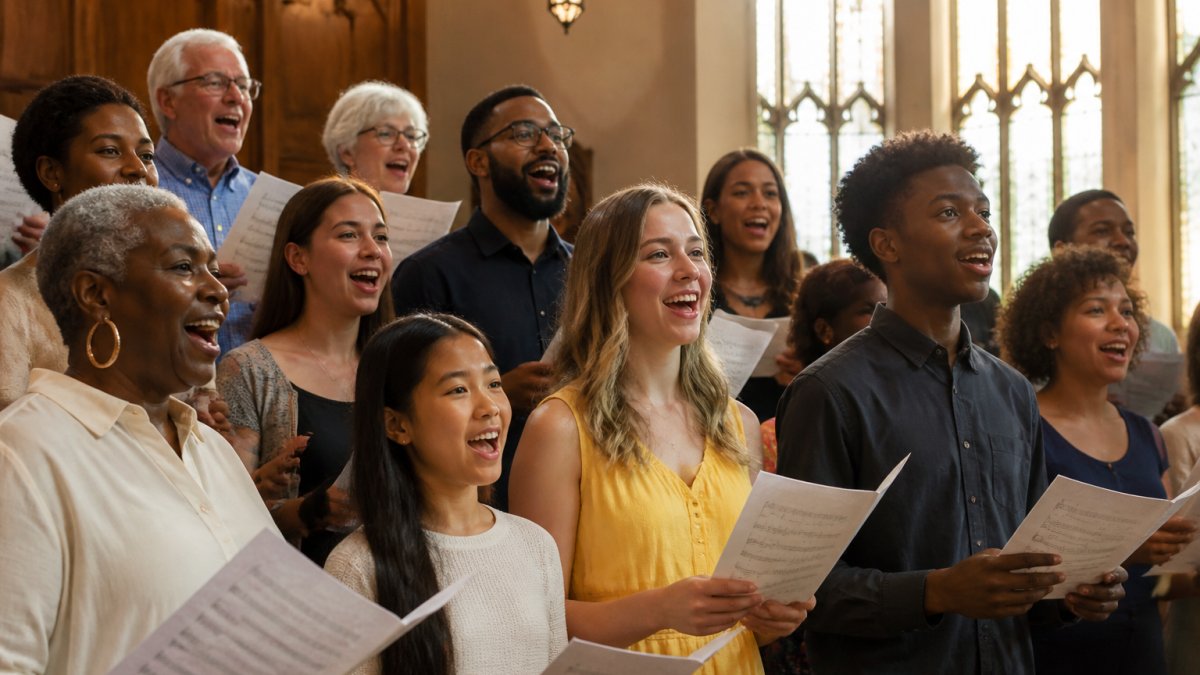
Start with these practical moves:
- Drop the audition. Replace it with a welcome conversation. Ask what part feels comfortable, not what part they can prove.
- Offer multiple entry points. A traditional choir, a contemporary praise team, a handbell group, and a children's ensemble can coexist.
- Provide materials in accessible formats. Large print, lyric sheets, and simple recordings let people learn by ear.
- Pair newcomers with a mentor. One experienced singer beside a first-timer changes everything.
A common mistake is launching a separate "inclusive" group that quietly becomes a side room. Inclusion means the main ensemble, not a satellite. If your choir loft looks the same in three years, the invitation was not real.
Define Church Music Ministry Roles Beyond the Stage
Church music ministry roles extend far beyond who stands at the microphone. A healthy program names the work that happens offstage, because unnamed work goes undone.
Consider these roles, whether paid or volunteer:
| Role | Core Responsibility | Where It Happens |
|---|---|---|
| Worship leader | Shapes the service arc and leads the congregation | Rehearsal and service |
| Section leaders | Support vocalists and instrumentalists in their part | Rehearsal |
| Music librarian | Tracks scores, licences, and arrangements | Office |
| Audio technician | Runs sound and recordings | Booth |
| Pastoral liaison | Checks in on team members and their families | Everywhere |
| Scheduler | Coordinates availability and rotation | Behind the scenes |
The pastoral liaison is the role most churches skip, and the one that matters most. Someone needs to notice when a faithful volunteer has been carrying the same load for years without a break.
Write these roles down and rotate them. Shared ownership keeps a music ministry from becoming one person's private burden.
Introducing New Worship Songs Without Losing the Congregation
Introducing new worship songs works best when the congregation hears a song before they are asked to sing it.
- Preview it instrumentally. Play the melody as a prelude or offertory for two or three weeks. No announcement, no pressure, just let the tune become familiar.
- Teach one line by ear. Have the leader sing a single phrase a cappella and invite the room to echo it back. This is the oldest teaching method in the church and it still works; it is how most congregations learned hymns before printed hymnals were common.
- Pair it with an old favorite. Place the new song beside something the congregation already loves, ideally in the same key and tempo family so the transition feels seamless rather than jarring.
- Print it large and simple. Use large-print lyric sheets with the melody line only, no dense arrangements. People who cannot read music can still follow a single line and a repeated chorus.
- Keep it for a season. Repeat it monthly until it belongs to the people. A song becomes "ours" somewhere around the fourth or fifth hearing, not the first.
- Record a simple version. A phone recording of the leader and one instrument, shared with the congregation, lets people learn at home and lets families with children practice in the car.
What most guides miss is that song selection is a pastoral act, not a programming decision. A song the congregation cannot reach, too high, too syncopated, too wordy, divides the room into watchers and performers.
This is where the book's emphasis on singing "by heart" matters. The songs a congregation truly owns are the ones they can sing without looking.
Ask your oldest member and your youngest member what they want to sing. When both are represented in your repertoire, you are building something that lasts, and you are ensuring that each person's music has a place.
Worship Team Leadership: Serving the Community, Not the Performance
Worship team leadership is service, not performance. The leader's job is to make it easier for everyone else to sing, play, and pray, and that posture changes every decision.
Here is how servant leadership shows up in practice:
- Rehearse the people, not just the notes. Spend the first ten minutes of rehearsal on connection and prayer.
- Give feedback that builds. Name one specific thing each person did well before offering a correction.
- Rotate the spotlight. Give different vocalists and instrumentalists a chance to lead.
- Model humility. Let the team see you receive feedback as readily as you give it.
Many worship leaders find that the team's spiritual health predicts its musical health far more reliably than its skill level does. A team that trusts each other sings with one voice.
Budget, Safeguarding, and Accessibility: The Foundations of Community Worship
The foundations of a sustainable music ministry are unglamorous: a budget, safeguarding practices, and accessibility planning.
Budget. Plan for scores and licences, instrument maintenance, sound equipment, and training. Smaller churches often find that a modest annual line item, reviewed each year, prevents the scramble that comes from treating music as an afterthought.
Safeguarding. Anyone working with children or vulnerable adults should be screened and trained according to your denomination's and local authority's requirements. Check your own governing body's official guidance for the current standards that apply to you.
Accessibility. Ask whether a wheelchair user can reach the choir loft, whether lyrics are visible from every seat, and whether a hearing loop is available. These are not extras.
Measure What Matters: Outcomes and Sustainability for Community Worship
Measuring community worship outcomes is not about attendance alone.
Track a small set of indicators, and review them on a fixed schedule, quarterly is enough for a volunteer-run program:
- Participation breadth. How many distinct people sang or played over the last quarter? Count names, not slots. If the same eight people fill every role, breadth is flat.
- Age and language spread. Does your ensemble reflect your congregation? Compare the ensemble's age range and languages to the pews. A gap is a signal, not a failure.
- Newcomer retention. Do first-time volunteers return for a second term? A low return rate usually points to onboarding, not talent.
- Congregational singing. Do people in the pews join in, or watch? Ask two ushers and two long-time members to give you an honest read each month.
- Volunteer wellbeing. Are team members refreshed or depleted? A short, anonymous check-in twice a year catches burnout before it becomes a resignation.
Collecting this does not require software. A shared spreadsheet and a fifteen-minute quarterly meeting with your leadership team is enough. The discipline is in the rhythm, not the tooling.
What most programs skip is the response plan. Decide in advance what you will do when an indicator slips.
Sustainability also means planning for succession. Name a second person for every key role, the music librarian, the scheduler, the audio lead, and give them real responsibility before they are needed.
This is responsible stewardship in practice: not perfect music, but honest measurement, a willingness to change course, and a plan that outlasts any single leader.
Conclusion: Let Go and Let God Build Your Community Worship
Building community worship is a long obedience in the same direction, and it rarely looks like the polished production we imagine.
Let go and let God. Aim for responsible stewardship rather than perfect music. If you want a companion for the journey, Let Her Sing! is our invitation to every voice in your church, a call to build a wide-open-door music program where each person has a place. Let Her Sing! on Amazon
Start with one conversation this week. Ask someone who has never been asked. Then watch what God builds.
Frequently Asked Questions
How do you start a community worship music program in a church?
Begin with a needs assessment: talk to congregation members about their musical interests and barriers to participation. Form a small planning team, define clear goals for community worship, and start with one inclusive event like a hymn sing or a beginner-friendly choir rehearsal. Recruit volunteers for church music ministry roles, set a simple budget, and review progress after three months. The key is to start small and let the program grow organically.
How can a church make its music program more inclusive?
An inclusive church choir removes barriers to participation. Offer multiple ways to join: singing, playing an instrument, reading Scripture, or helping with sound. Provide large-print lyrics, reserve seating for wheelchairs, and use simple, repetitive songs that don't require formal training. Invite people of all ages and skill levels, and avoid audition-based membership. When introducing new worship songs, teach them line by line and pair them with familiar favorites so everyone can join in.
What roles can people take in a church music ministry besides singing or playing?
Church music ministry roles go far beyond the stage. People can serve as greeters, rehearsal hosts, music librarians, sound technicians, lyric projection operators, transportation helpers for elderly members, or prayer partners for the team. Others can coordinate schedules, manage instruments, or lead small-group singing. These roles allow everyone to contribute to community worship, regardless of musical ability, and they build a stronger sense of belonging.
How should church music leaders introduce new songs?
Introduce new worship songs gradually. Teach the melody and lyrics during a rehearsal or a short pre-service session, then sing the song as a special piece before adding it to regular worship. Use familiar chord progressions and avoid complex rhythms at first. Pair new songs with well-known ones to create a bridge. Ask for feedback from the congregation and be willing to set a song aside if it doesn't resonate. The goal is participation, not performance.
How do you measure whether a community worship program is working?
Look for signs of participation and connection rather than musical perfection. Track attendance at rehearsals and services, count how many people volunteer for church music ministry roles, and note whether new faces appear on stage or in the choir. Ask simple questions: Are more people singing? Do newcomers return? Are small groups forming around music? Use short surveys and informal conversations. Success in community worship is measured by growing involvement and a sense of belonging, not by flawless performance.