 How-to
Choir Participation Growth Strategies That Work
Table of Contents
- Start With a Baseline: Know Where Your Choir Participation Stands
- Church Choir Recruitment and Retention: Building a Wide-Open Door
- How to Motivate Choir Members Without Pressure
- Choir Rehearsal Strategies That Make People Want to Return
- Inclusive Church Music Ministry: Removing the Barriers to Singing
- Open Rehearsals, Sing-Alongs, and Public Visibility
- Digital Outreach and Member Feedback: Measuring What Changes
- Conclusion: Let Go and Let God, but Steward the Work
- Frequently Asked Questions
Last Updated: October 17, 2026
Start With a Baseline: Know Where Your Choir Participation Stands
You cannot grow what you have never counted. That is the first lesson in any honest look at choir participation growth strategies, and it is the one most churches skip. Many congregations launch bold new music plans without a single number to compare against, then wonder why no one can tell if anything changed.
Before you change a thing, measure the room you already have.
Three Numbers to Track Before You Change Anything
Track these three figures every month:
- Active singers: people who sang in at least one rehearsal or service this month
- Return rate: how many of last month's singers came back this month
- Sunday participation: how many voices joined the congregation's singing, not just the choir's
Write them down in a simple notebook or spreadsheet. Keep it visible. A common mistake is tracking only choir attendance and ignoring the congregation. Both matter. The church choir exists to serve the whole room, not to fill a stage.
Setting Realistic Targets for Choir Growth
Set targets that are small and checkable. A volunteer choir that adds one or two steady singers a season is moving in the right direction. A congregation where a few more voices join the singing each month is growing too.
Avoid the trap of aiming for a perfect sound. Aim for a wider door. Numbers give you honesty, and honesty gives you a plan.
Church Choir Recruitment and Retention: Building a Wide-Open Door
Recruitment and retention are two sides of one door. A church choir recruitment and retention plan works best when the invitation is clear and the welcome is warm. Many churches excel at one and neglect the other. They fill the loft in September and lose half of it by Christmas.
The fix starts with how you ask.
Recruitment Funnels for Different Groups in Your Congregation
Different people need different invitations. Try these funnels:
- Long-time members: a personal phone call from the director, not a bulletin notice
- Young families: a short, low-commitment season, such as a four-week Christmas choir
- Teens: a youth music night with food and no audition
Each group hears a different version of the same message: there is a place for your voice here.
Retention Habits That Keep Singers Coming Back
New members stay when they feel seen. Learn names fast. Pair a new singer with a seasoned one. Send a short note after an absence. Keep rehearsal start and end times reliable, because people plan their week around them.
Most of all, thank people. A singer who feels appreciated on Sunday comes back on Wednesday.
How to Motivate Choir Members Without Pressure
Motivation grows from purpose, not pressure. Singers who understand why the choir exists will show up for more than the music. They show up for each other and for the congregation they serve.
The mistake many churches make is treating motivation as a personality trait, the director is either inspiring or not. In reality, motivation is a system.
Clarify Goals and Expectations Up Front
Singers stay when they know what they are signing up for. A common pattern in growing church choirs is a simple, written covenant: what the choir does, when it rehearses, how many services per month, and what happens when someone misses.
This is not bureaucracy. It is respect. A singer who knows the commitment can say yes with confidence, and a singer who cannot meet it can step back without shame. Both outcomes protect the community.
Use a Simple Motivation Check-In Each Season
Ask every singer two questions, in writing or in a short conversation:
- What makes you want to come back?
- What makes it hard to come back?
Write down the answers. Look for patterns. If several people mention the same barrier, a late rehearsal time, a song they find impossible, a feeling of not being missed, that is your next fix. This is evidence-led iteration at the smallest scale, and it works because it treats singers as partners rather than volunteers to be managed.
Rotate Responsibility Without Rotating Pressure
Give more people a piece of the work, but keep the pieces small and visible. One singer can manage the folder table. Another can send the reminder text.
The key is to ask, not assign. A singer who volunteers for a small task is signaling that they want to belong more deeply.
Protect Rest and Celebrate Faithfulness
A tired volunteer is a leaving volunteer. Build rest into the calendar: a month with no extra rehearsals, a Sunday when the choir simply sits and sings with the congregation.
Guilt wears thin. Purpose holds. When singers see their voice as a gift to the room, and see that the room notices, the rehearsal calendar stops feeling like a chore.
Choir Rehearsal Strategies That Make People Want to Return
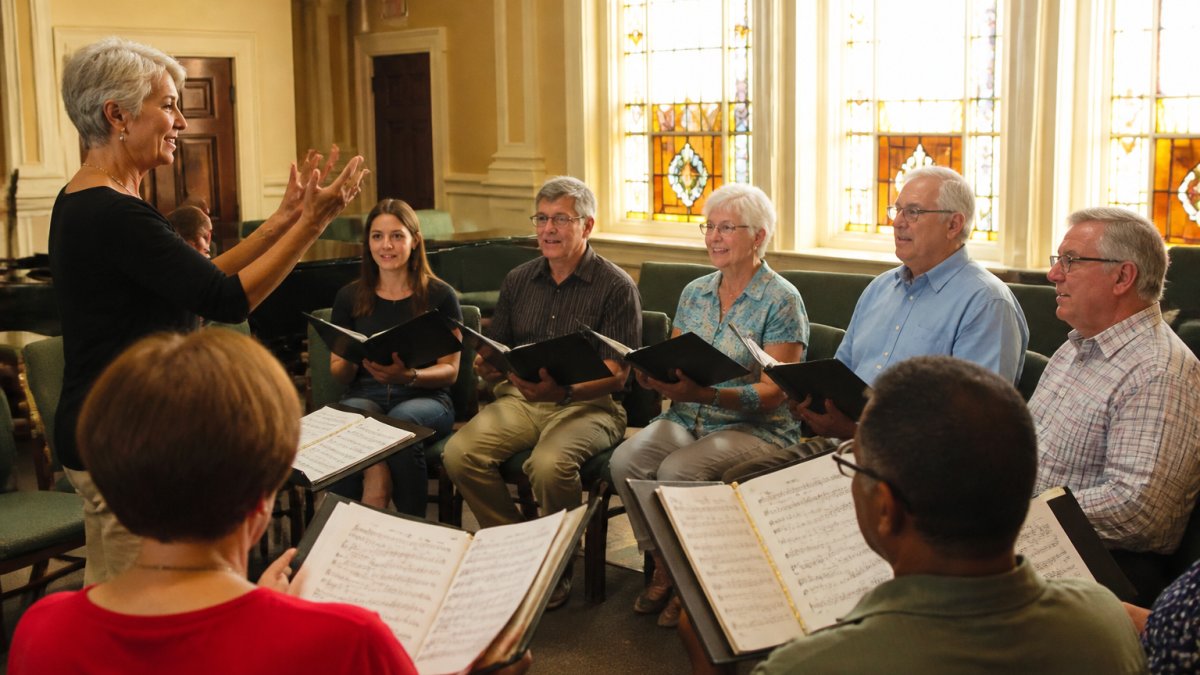
A rehearsal is a promise you keep every week. Good choir rehearsal strategies make that promise worth showing up for: people leave encouraged, not drained. The best rehearsals feel like a gathering, not a test.
A Rehearsal Structure That Works for Mixed Experience Levels
Use the same shape every week so people can relax into it:
- Gather and warm up (10 minutes): easy breathing and simple rounds everyone can sing
- Teach the hardest part first (15 minutes): fresh ears learn best early
- Sing in sections, then together (15 minutes): pair strong readers with beginners
- Run the Sunday pieces (15 minutes): stop only to fix what truly needs fixing
- Close with a full run and a thank-you (5 minutes): end on a win, not a correction
This structure respects beginners without boring experienced singers. It also keeps the rehearsal moving, which keeps energy up.
Do not spend the whole rehearsal drilling the weakest section. Beginners feel singled out and strong singers get restless. Fix one thing well, then move on.
Inclusive Church Music Ministry: Removing the Barriers to Singing
An inclusive church music ministry asks a harder question than "who can sing?" It asks, "who can't join us yet, and why?" Many people want to sing and quietly believe they are not allowed to. Your job is to remove that belief.
Common barriers and simple fixes:
- "I can't read music." Offer parts by ear, recordings, and lyric sheets.
- "I'm too old or too young." Build a mixed-age choir and say so out loud.
- "I don't know anyone." Assign a buddy for the first month.
When every voice has a door, the whole congregation sings louder.
Open Rehearsals, Sing-Alongs, and Public Visibility
Visibility invites participation. People join what they can see and hear. But most church choirs stop at announcing an event and hoping people show up.
An open rehearsal or a sing-along lowers the stakes and lets curious people try before they commit. The work is in what happens before, during, and after.
Build a Simple Recruitment Funnel for Each Event
Treat every public event as a funnel with four stages: awareness, first contact, first rehearsal, and follow-up. Different audiences enter at different points, so tailor the invitation:
- Long-time members: a personal phone call from the director, not a bulletin notice. Ask them to bring one friend.
- Young families: a short, low-commitment season, a four-week Christmas choir or a single-service Easter group, with childcare named explicitly.
- Teens: a youth music night with food, no audition, and a clear end time.
Each group hears a different version of the same message: there is a place for your voice here, and here is exactly how to find it.
Plan the Event Itself Around the First-Timer
An open rehearsal should feel like a gathering, not an audition. Start with a round everyone can sing by ear. Skip sight-reading. Put a seasoned singer beside every visitor.
A hymn sing-along works best when the congregation picks the songs in advance through a simple online form or a clipboard at the back.
Close the Loop with Follow-Up
The follow-up is where most choirs lose the growth they just earned. Within forty-eight hours of the event, send a short personal message, a text or a note, to every first-time visitor.
Then track it. Add a line to your baseline numbers: how many first-time visitors came, and how many returned within a month.
Use Digital Outreach to Extend the Invitation
A simple text reminder, a short rehearsal clip, or a sign-up form on the church website can reach people who never read the bulletin.
Public visibility builds a reputation for a wide-open door, and that reputation does the recruiting for you, but only if the door is actually easy to walk through.
Digital Outreach and Member Feedback: Measuring What Changes
Digital outreach extends the invitation beyond the building. A simple text reminder, a short rehearsal clip, or a sign-up form on the church website can reach people who never read the bulletin.
Then close the loop with feedback. Ask singers two questions each season:
- What makes you want to come back?
- What makes it hard to come back?
Write down the answers. Act on the ones you can. This is how evidence-led iteration works: you try something, you measure it, and you adjust.
Send one short text reminder the morning of rehearsal. It is the cheapest outreach you have, and it reaches the people who forgot, not the people who quit.
Conclusion: Let Go and Let God, but Steward the Work
Growing a choir is not about chasing perfect music. It is about faithful stewardship: counting honestly, inviting widely, and serving each singer well. Let go and let God with the results.
That is the heart of Let Her Sing!, a call to action for every church to make room for every voice.
Frequently Asked Questions
How can a church encourage more people to sing in the choir without auditions?
Drop the audition and make the first step low-commitment. Invite people to a single open rehearsal or a sing-along Sunday where no one is asked to commit. Pair each newcomer with an experienced singer, choose accessible repertoire in a comfortable range, and say plainly that the choir welcomes beginners. When people know they will not be tested or embarrassed, choir participation rises. Track how many first-timers return for a second rehearsal; that return rate tells you more about your welcome than any sign-up sheet.
How do you motivate choir members who are losing interest?
Ask them before you assume. A short conversation or anonymous survey often reveals the real issue: repertoire that feels stale, rehearsals that run long, or a sense that their voice is not needed. Rotate song styles, shorten rehearsals, and give members visible responsibility such as leading a warm-up or welcoming newcomers. Connect the singing to the congregation's worship rather than to performance quality. When people see their participation serving the community, motivation usually follows.
How often should a church choir rehearse?
There is no single right answer, but consistency matters more than frequency. Many volunteer choirs rehearse once a week before a Sunday service, with a shorter warm-up on the day. Choose a schedule your singers can actually keep, protect it, and publish it well in advance. If attendance is uneven, try a monthly longer rehearsal plus weekly short ones. Review attendance over a few months and adjust rather than adding sessions that people cannot attend.
What makes congregational singing more engaging for everyone?
Accessible music selection is the biggest lever. Choose songs in comfortable keys, with repeatable refrains, and teach new songs briefly before asking the congregation to join. Model singing from the front with confidence, use printed or projected words clearly, and include a mix of familiar and new material. Inclusive church music ministry also means considering language, hearing access, and different musical backgrounds so every voice has a place.
The challenge is real: many churches have a stage but no open door. Let Her Sing! offers a way forward, built on community-based worship and advocacy for inclusive congregational singing. It encourages the participation of every voice and a deeper understanding of communal worship. Get started with Let Her Sing! and build a music ministry where every voice has a place.