 Ultimate guide
Best Strategies for Participatory Worship in 2026
Table of Contents
- Best Strategies for Participatory Worship: A Practical Guide
- How to Encourage Congregational Singing
- Overcoming Barriers to Congregational Singing
- Worship Leadership Tips for Participation
- The Biblical Mandate for Participatory Worship
- Multi-Generational Engagement Strategies for Your Congregation
- Technical and AV Integration for Interactive Worship
- Conclusion: Building a Culture of Worship Participation
- Frequently Asked Questions
Last Updated: October 4, 2026
Best Strategies for Participatory Worship: A Practical Guide
Participatory worship structures a service so the congregation contributes actively, through singing, prayer, and response, rather than watching a performance from the pews. This guide covers the best strategies for participatory worship, from song selection to multi-generational engagement.
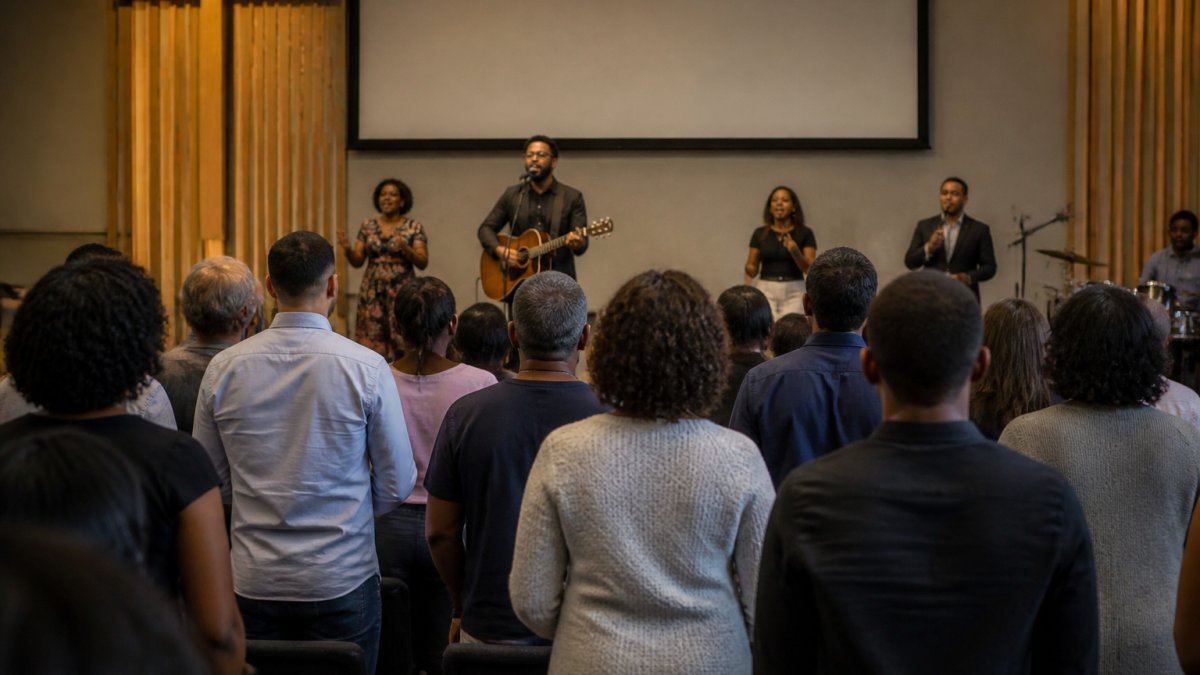
How to Encourage Congregational Singing
Encouraging congregational singing starts with choosing songs people can actually sing, then teaching new material without breaking the flow of worship. Most leaders do the opposite: they pick what inspires the team and hope the room follows. The congregation needs a comfortable range, repeated words, and enough familiarity to sing without staring at a screen.
Choosing Songs Your Congregation Can Actually Sing
A common mistake is judging a song by how it sounds on a recording rather than how it sits in a room. Recordings are mixed for a lead vocalist; congregational singing needs a melody that survives without one.
- Keep the melody within a comfortable range for untrained voices
- Choose songs with repeated phrases and predictable structures
- Limit new songs to one per service, placed after a familiar opener
Teaching New Songs Without Losing Momentum
New songs earn their place through repetition, not explanation. Introduce a chorus as a refrain within an existing song, sing it twice, and let it go. Return to it next week. By the third week, the room owns it.
Overcoming Barriers to Congregational Singing
Barriers to congregational singing fall into two categories: psychological and practical. Leaders tend to address the practical ones (volume, key, lyrics) while ignoring the psychological ones, which is why participation stalls even when the sound is perfect.
Psychological Barriers: Why People Stop Singing
Most people stop singing because they believe they cannot sing. That belief hardens in adolescence and rarely softens with age. The fix is not vocal training for the congregation; it is removing the audition mindset from the room.
- Avoid language that implies performance ("nailing it," "bringing it")
- Normalise imperfect voices from the platform
- Let the worship team sing at a volume that supports, not covers
Practical Barriers: Volume, Key, and Lyrics
Practical fixes are straightforward. If the congregation cannot hear itself, if the lyrics lag behind the music, or if the key sits too high, it will not sing.
| Barrier | Fix | Effect on Participation |
|---|---|---|
| Band too loud | Lower stage volume, use in-ear monitors | Room hears itself sing |
| Key too high | Transpose down a step or two | Untrained voices join in |
| Lyrics mistimed | Rehearse transitions with the AV team | Congregation stays with the song |
| Unfamiliar melody | Repeat the chorus, teach by singing | New songs stick by week three |
Worship Leadership Tips for Participation
Worship leadership for participation looks different from worship leadership for performance. The leader's job shifts from delivering a moment to hosting one: fewer platform theatrics, more eye contact, and deliberate space for the room to carry the song. But the mechanics matter more than the posture, and most guides stop at the posture.
The Hosting Mindset vs. the Performing Mindset
A performing leader asks, "Did the room respond to me?" A hosting leader asks, "Did the room sing without me?" That question reshapes every platform decision. Practitioners who make this shift often observe the congregation's volume rising, not because the songs changed, but because the leader stopped competing with the room.
Concrete hosting behaviours that move the needle:
- Sing into the microphone at a conversational level, not a performance level. When the leader's voice dominates the mix, the congregation defers. When it sits inside the mix, the congregation joins.
- Step back from the mic during the final chorus of at least one song per service. This signals that the room, not the platform, owns the moment.
- Use spoken invitations of ten words or fewer. "Let's sing this together" outperforms a two-minute exhortation; extended talking gives the room permission to disengage.
The Introvert Problem Nobody Names
A significant share of any congregation is introverted, and introversion is not a barrier to participation, it is a barrier to extroverted participation. Leaders who assume engagement looks like raised hands, audible amens, or visible emotion will misread half the room. The introverted worshipper often participates fully while appearing still.
Practical implications:
- Do not equate stillness with disengagement. A congregation that sings quietly but consistently is healthier than one that sings loudly for two songs then goes silent.
- Offer multiple modes of participation within a single service: singing, spoken response, silent prayer, written reflection. Introverts often engage more deeply through the written or silent mode.
- Avoid calling on individuals spontaneously. The fear of being singled out is one of the most common reasons people stop singing in the first place.
When to Hand the Song to the Congregation
The most underused leadership move is the deliberate handoff: a verse or chorus where the band drops out entirely and the congregation carries the melody unaccompanied. Done once per service, it builds confidence faster than any teaching technique.
Schedule the handoff on the second or third song, after the room has warmed up but before energy dips. Choose a song the congregation already knows well, never a new one.
The Biblical Mandate for Participatory Worship
The biblical mandate for participatory worship rests on the priesthood of all believers, the teaching that every Christian shares in the ministry of the congregation rather than delegating it to a professional class.
This is the theological framework that separates participatory worship from its alternatives. The theological foundations of the priesthood of all believers trace this theme from the Old Testament through the New, and the practical implication is direct: a silent congregation is a theological problem, not just a musical one.
Multi-Generational Engagement Strategies for Your Congregation
Multi-generational engagement fails when churches split the room by age. Separate services solve a scheduling problem while creating a discipleship one. The stronger approach is a shared repertoire every generation recognises, with new material layered in slowly.
- Ask older members which songs formed their faith
- Ask younger members which songs they already know
- Build a rotating core of songs that overlap both lists
Technical and AV Integration for Interactive Worship
Technical and AV integration is the most overlooked lever for interactive worship, and the one most guides reduce to a list of presentation software. The real question is not which lyric-display tool a church uses; it is how technology can invite participation rather than replace it. Most churches have the hardware; few have a strategy for using it interactively.
The Distraction Test
Before adopting any interactive tool, apply one filter: does this draw the congregation toward the worship, or toward the screen? A poll asking people to reflect on the sermon text deepens engagement; one asking them to rate the worship band pulls them out of it.
A useful rule of thumb: if the interaction requires more than fifteen seconds of explanation from the platform, it costs more participation than it creates. Keep the mechanism invisible.
Real-Time Interactive Tools That Work
- Live polls and Q&A during the sermon. Tools like Slido, Mentimeter, and Poll Everywhere let congregants submit questions or respond to a prompt from their phones. Display results on the main screen and have the preacher respond in real time, turning a monologue into a conversation without anyone speaking aloud.
- Live chat for online congregants. For hybrid services, a moderated chat channel gives remote participants a genuine role. Assign a volunteer to surface two or three comments or questions to the preacher during the service, not after it. "Here's what someone just asked" is the difference between watching and participating.
- Interactive lyric and response apps. Apps that let congregants follow lyrics, submit prayer requests, or respond to liturgical prompts can supplement projected lyrics. The trade-off: phones in hand can become phones in use. Many churches find one clearly bounded interactive moment per service works better than continuous app engagement.
The AV Setup That Makes Participation Possible
The technology that matters most is not the interactive layer, it is the foundation. When a congregation cannot see the lyrics, follow the melody, or hear itself, participation drops regardless of how well the service is planned.
| Element | Common Failure | Fix |
|---|---|---|
| Lyric display | Font too small from the back row; lyrics change before the line is sung | Test from the back row; rehearse transitions with the AV team |
| Stage volume | Band loud enough that the room cannot hear itself | Lower stage volume; use in-ear monitors so the band hears itself without filling the room |
| Monitor mix | Worship team hears only itself | Add a congregation mic to the monitor mix so the team hears the room |
| Online audio | Remote listeners hear only the platform, not the room | Place a room mic in the congregation and mix it into the stream |
Presentation software choices matter here. ProPresenter handles multi-screen lyric display for larger venues, MediaShout prioritises simplicity for volunteer teams, and OpenLP offers a free option for smaller congregations.
The Hybrid Congregation
For churches streaming services, the online congregation is not an audience, it is a second room. Treating it as an audience produces passive viewers; treating it as a room produces participants. Practical moves:
- Greet online participants by name at the start of the service, as you would someone walking in.
- Give the online room a specific moment to respond, a chat prompt, a poll, a prayer request, at least once per service.
- Have someone on the AV team monitor the chat and feed one or two responses to the platform in real time.
guidance on accessible worship design for congregations
Conclusion: Building a Culture of Worship Participation
Building a culture of worship participation takes longer than a single service overhaul: consistent song choices, honest attention to the psychological barriers in the room, and a leadership posture that makes space for every voice rather than filling it.
That is the work Let Her Sing! exists to support. Let Her Sing! focuses on community-based worship and advocacy for inclusive congregational singing, serving as an encouraging resource for leaders who want every voice in the church to take part in the life and worship of the congregation.
Frequently Asked Questions
What is the difference between performance-based and participatory worship?
Performance-based worship centers on a skilled worship team or choir delivering music to a listening congregation. Participatory worship invites every voice to join in, treating the congregation as the primary choir. The focus shifts from polished presentation to collective expression. In practice, this means choosing songs in singable keys, projecting lyrics clearly, and creating space for the congregation to hear themselves and each other. The goal is not to eliminate excellence but to redirect it toward enabling the whole body to participate.
How can worship leaders encourage congregational singing?
Start by selecting songs with simple, memorable melodies in keys that suit the average voice, typically between middle C and the D above it. Teach new songs gradually, perhaps by singing a verse as a choir piece first. Reduce the band's volume during verses so the congregation can hear themselves. Use visual cues like raised hands or direct eye contact to invite participation. Most importantly, model singing yourself with visible enthusiasm. When the leader sings with genuine joy, the congregation responds in kind.
How do you engage a congregation that is hesitant to sing?
Hesitant congregations often need permission and practice. Begin by acknowledging their discomfort from the platform without judgment. Introduce simpler songs, perhaps older hymns or choruses with repetitive refrains. Try a call-and-response format where the leader sings a line and the congregation echoes it. Consider a short teaching moment about why singing together matters theologically. Over time, these small steps build confidence. Let Her Sing! provides a framework for inclusive musical engagement.
What are the biblical foundations for participatory worship?
The Bible consistently describes worship as a communal act. The Psalms repeatedly call the assembly to sing together: 'Sing to the Lord, all the earth' (Psalm 96:1). The priesthood of all believers, taught in 1 Peter 2:9, affirms that every Christian has direct access to God and a role in worship. Ephesians 5:19 instructs believers to speak to one another in psalms, hymns, and spiritual songs. These passages point to a worship practice where every voice matters, not just those on the platform.
What practical steps can we take to overcome barriers to congregational singing?
Address the most common barriers directly. Lower the key if songs sit too high for your congregation. Reduce the band's volume during singing so voices can be heard. Display lyrics with large, high-contrast text. Avoid songs with complex rhythms or irregular phrasing. Train your sound team to mix for congregational voice, not just the stage. For psychological barriers, create a non-judgmental atmosphere where imperfect singing is welcome. These adjustments make participation feel possible rather than intimidating.
How do we measure whether our participatory worship efforts are working?
Look for observable changes rather than formal metrics. Are more people singing during the first verse, not just the chorus? Has the volume of congregational voices increased? Do you see people of different ages standing together and engaging? Ask your worship team and a few trusted congregants for honest feedback. You can also track whether new songs are being sung by the congregation within a few weeks of introduction. Success is not about perfection but about a growing sense of shared ownership in worship.
A silent room is not a reverent one, and rebuilding congregational singing starts with the resources and encouragement your team needs to lead differently. Let Her Sing! is built around community-based worship and inclusive congregational singing, offering a practical framework for leaders who want every voice in the church to participate. Explore the project and see how it can support your worship ministry. Show Me.