 How-to
Worship Ministry Team Training Ideas That Work
Table of Contents
- Start With the Heart: Why Worship Team Training Matters
- A Ready-to-Run Worship Team Workshop Agenda (With Timings)
- Worship Team Building Exercises for Voices, Instruments, and Sound
- Worship Team Rehearsal Tips: Better Sets, Better Communication
- Worship Team Devotional Ideas That Hold a Team Together
- Training Plans for Different Team Sizes and Experience Levels
- Measuring Growth and Avoiding Common Training Mistakes
- Conclusion: Build the Foundation, Then Let It Grow
- Frequently Asked Questions
Last Updated: October 12, 2026
Start With the Heart: Why Worship Team Training Matters
Worship ministry team training ideas work best when they start with people, not music. That is the core conviction behind Let Her Sing!, a call for every voice to take part in the life and worship of the congregation.
Most teams rehearse notes. Fewer teams train people. That gap is where burnout, silence, and shrinking choirs quietly begin.
The good news: you do not need a big budget or a professional coach to change this. You need a plan, a room, and a leader willing to serve the team rather than perform for them.
A Ready-to-Run Worship Team Workshop Agenda (With Timings)
A two-hour evening workshop gives you enough time to teach, practice, and pray together without exhausting volunteers who work full days. Keep it moving. Long silences kill momentum, and so do lectures.
A Two-Hour Evening Workshop Outline
- 0:00-0:15, Welcome and opening prayer. Set the tone. Read one short psalm aloud together.
- 0:15-0:35, Devotional and vision. One leader shares why the team exists and who it serves.
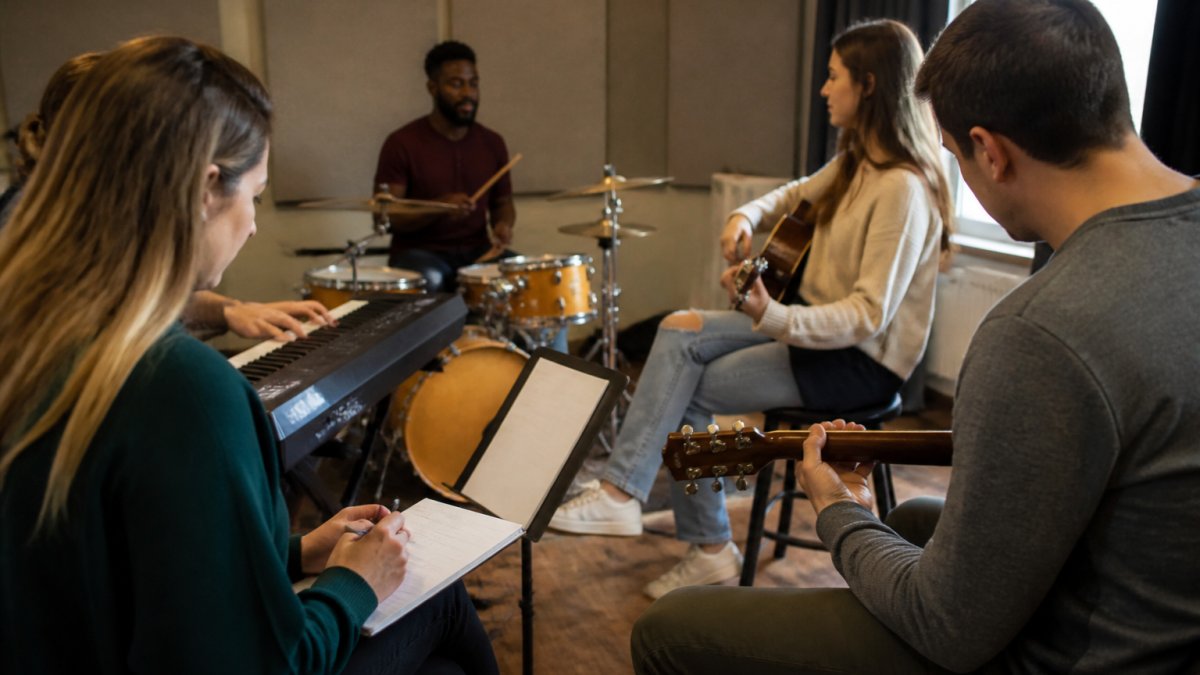
- 0:35-1:00, Vocal and instrumental breakout. Split into groups by role.
- 1:00-1:20, Full-group run-through. Two songs, start to finish, no stopping.
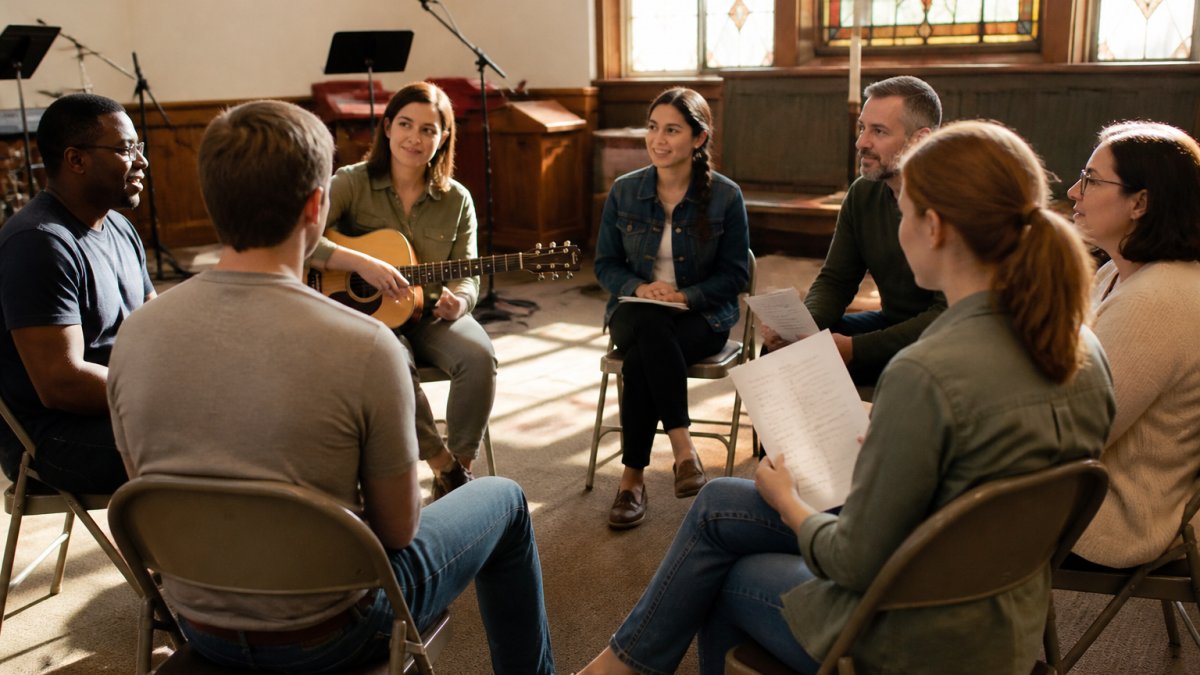
- 1:20-1:40, Feedback circle. Each person names one thing that worked and one thing to try.
- 1:40-1:55, Skill clinic. Teach one new skill, such as breath support or sound check basics.
- 1:55-2:00, Closing prayer and next steps. Name one goal for the coming month.
Worship Team Building Exercises for Voices, Instruments, and Sound
Different roles need different practice. A single group exercise wastes time for half the room. Split up, then come back together stronger.
Exercises for Vocalists
- Breath ladder. Sing one phrase on a single breath, then add a word each round.
- Blend circle. Stand in a tight circle and match vowels on one sustained note.
- Text-first reading. Speak the lyric before singing it, so meaning leads melody.
Exercises for Instrumentalists and Sound Volunteers
- Dynamic mapping. Play one chorus at three volume levels and name each one.
- Listening drill. Instruments play while the sound volunteer describes what they hear.
- Silence practice. Everyone drops out for four bars, then returns on cue together.
Vocal health guidance for singers
Worship Team Rehearsal Tips: Better Sets, Better Communication
The best worship team rehearsal tips all point to one habit: prepare the set before the room fills up. A worship set is not a playlist. It is a journey with a beginning, a turn, and a landing.
Plan songs in keys your congregation can actually sing. If the room cannot follow, the arrangement does not matter.
- Send charts and recordings at least four days ahead.
- Name the key, tempo, and who starts each song.
- Assign one person to watch the congregation, not the band.
- Cut one song if the set feels crowded.
How to Give Feedback That Builds Instead of Breaks
Most worship teams do not have a feedback problem. They have a feedback timing problem. Correction offered in the middle of a run-through feels like a public shaming, even when it is meant kindly. Correction offered after the run-through, in private, lands as care.
A simple pattern that works for volunteers of any skill level:
- Ask before you tell. "How did that feel to you?" The singer usually names the same issue you heard.
- Name one specific thing that worked. "The second verse held together even when the drums pushed."
- Name one specific thing to try. "Next time, watch my hand on the last chorus."
- Stop there. One correction per rehearsal per person. More than that and nothing sticks.
Rehearsal Communication Habits That Prevent Tension
Tension on a worship team rarely comes from bad musicianship. It comes from unclear expectations. Three habits head off most of it:
- One voice per role. The worship leader sets the set. The sound volunteer owns the mix. The section leader owns the blend. When everyone corrects everyone, no one is trusted.
- A weekly written note. After rehearsal, send a short message: what changed, what to practice, what time to arrive Sunday. Volunteers who know what is expected do not have to guess, and guessing is where resentment grows.
- A standing invitation to speak privately. Tell the team, out loud, that anyone can come to you after rehearsal with a concern. Most will not. The ones who do are the ones you would have lost otherwise.
A Note on Volunteer Wellbeing
Sustainable schedules are a training issue, not just a scheduling issue. A team that rehearses twice a week and serves every Sunday will lose people to exhaustion, and exhausted volunteers do not learn. Many churches find that a two-week rotation, with one rehearsal per service, keeps people fresh enough to actually grow. If a volunteer is carrying three roles, that is not dedication. That is a gap in the team that training should close.
Research on music and community wellbeing
Worship Team Devotional Ideas That Hold a Team Together
Worship team devotional ideas keep a group from becoming a rota. Rotas fill slots. Devotions build people.
Try a five-minute rhythm before every rehearsal:
- Read one verse aloud.
- Ask one person to say what it means to them.
- Pray for one member by name.
Once a month, go deeper. Share a meal. Tell the story of how each person came to faith. Sing a song nobody has rehearsed, just for joy.
This is the community the church was made for, and it costs nothing but time.
Training Plans for Different Team Sizes and Experience Levels
Small teams and large teams need different plans. So do new believers and twenty-year veterans.
| Team Size | Training Focus | Frequency | Format |
|---|---|---|---|
| 1-5 people | Role swapping and basic skills | Monthly | 90-minute workshop |
| 6-15 people | Sectional practice and mentoring | Twice monthly | Split breakouts |
| 16+ people | Section leaders and apprentices | Weekly | 30-minute huddle |
For new teams, teach one skill per month. Do not stack lessons.
For experienced teams, apprentice someone. Every strong player should be training a replacement.
Measuring Growth and Avoiding Common Training Mistakes
You can measure growth without turning your team into a spreadsheet. But you do need something to look at, or training becomes a feeling instead of a practice. Most teams that stall are not lazy. They simply never defined what "better" would look like.
Three Simple Indicators of Progress
Track these once a quarter, not once a week:
- Who can lead alone. Count the people who could carry a song, a prayer, or a sound check without you in the room. That number is your real capacity.
- Who showed up consistently. Attendance consistency tells you whether training is worth their time. If it is not, the problem is usually the training, not the people.
- Who is new. If no one has joined the team in six months, your training is probably inward-facing. A healthy team always has a next person in view.
A Five-Minute Follow-Up That Makes Training Stick
Most workshops fail because nothing happens after them. Try this instead: at the end of every training session, each person writes one sentence on a card.
"By next month, I will practice ______ so that ______."
Collect the cards. Hand them back at the next rehearsal. Ask one person to share how it went. That single habit does more for retention than any curriculum, because it turns a workshop into a commitment.
Common Training Mistakes We See
- Training only the talented, ignoring the willing.
- Running workshops with no follow-up.
- Letting one person carry every role.
- Filling the stage with players who do not support the ministry.
The last one matters most. A skilled musician who undermines the mission does more harm than a beginner who loves the room. The stage is sacred, and it should be populated by responsible stewards, not by whoever happens to be available. That is not a talent standard. It is a stewardship standard, and it applies to the newest volunteer and the most seasoned player alike.
Guidance on building healthy volunteer teams
Conclusion: Build the Foundation, Then Let It Grow
Training a worship team is slow work, and that is the point. Foundations take time. Fruit takes longer.
If your team feels stuck, start with one workshop, one devotional rhythm, and one apprentice. Then let go and let God grow it.
Let Her Sing! exists to help churches invite every voice into the life of worship, and our book walks through how to build an inclusive, wide-open music program from wherever you are today. Get started with Let Her Sing! and give every member of your congregation a place to sing.
Frequently Asked Questions
What should a worship team workshop include?
A useful workshop mixes three things: a short devotional or heart-focused opening, a practical skill block (vocal technique, instrument blend, or sound basics), and a rehearsal-style run-through where the team applies what it just learned. Keep the whole session to about two hours, leave room for feedback, and end with prayer. Include vocalists, instrumentalists, and sound volunteers together so everyone hears the same expectations rather than training in separate silos.
How can a church train worship team members who have never led before?
Pair new leaders with someone experienced. Have them co-lead one song in rehearsal, then one song in a service, with the mentor standing nearby. Give them a simple checklist: song key, tempo, who starts, and what to say between songs. Apprenticing works better than classroom instruction because new leaders learn the feel of a service while someone they trust is beside them.
What are some good team building exercises for church leaders?
Try a listening round where one person plays or sings a phrase and the rest echo it back, then rotate leaders. Another option is a 'tell me your story' circle where each member shares how they came to faith and to music. These exercises build the trust that worship team building exercises aim for, and they reveal who is ready for more responsibility.
How do we know our worship team training is actually working?
Watch for changes you can see and hear: fewer rehearsal stoppages, members volunteering to lead, newer singers joining the group, and smoother transitions in the service. Ask the team two or three simple questions after each workshop about what helped and what confused them, and track the answers over a few months. Growth in participation and confidence is the clearest sign your training is doing its job.