 Listicle
Best Worship Resources for 2026: A Guide to Inclusive Church Music
Last Updated: November 10, 2026
Quick Summary
The best worship resources for 2026 are tools that help a real congregation sing, judged on congregational fit, accessibility and licensing, workflow fit, cost, and leadership support. Build an inclusive program by auditing who is missing, choosing singable songs, and making space for every voice.
- Judge every worship resource on five criteria, including congregational fit and leadership support.
- The Revised Common Lectionary gives churches a weekly structure that works across generations.
- Taizé chants are short, repetitive, and easy for untrained singers of any age to join.
- Teach a new song by ear, one line at a time, before the service starts.
- Pilot a resource for one month with a small team before committing.
Table of Contents
- What Makes a Worship Resource Worth Using in 2026
- Worship Planning Resources That Keep Sunday Morning Organized
- All-Age Worship Resources for Blended Congregations
- Inclusive Church Music: Building a Wide-Open-Door Program
- Congregational Singing Ideas That Get Every Voice Involved
- Song Discovery and Rehearsal Tools for Worship Teams
- How to Choose Your Church's Worship Resources for 2026
- Start Building Your Inclusive Worship Plan This Week
- Frequently Asked Questions
What Makes a Worship Resource Worth Using in 2026
A worship resource earns its place when it helps a real congregation sing, not when it fills a folder with downloads nobody opens. That is the standard we hold at Let Her Sing!, and it is the test we apply to every option in this guide to the best worship resources for in 2026.
Most churches do not lack material. They lack a way to sort it. A worship leader can find a hundred song lists before lunch and still not know which one fits the people in the pews on Sunday morning. So we built this guide around usefulness rather than volume.
Below, we walk through the tools, planning aids, and inclusive church music ideas that actually support a congregation. The throughline is simple: a resource is only as good as the participation it produces.
Selection Criteria for Churches of Any Size
We judge every worship resource on five things: whether it serves the whole congregation, how it handles accessibility and licensing, whether it fits your existing planning workflow, what it costs in time and money, and whether it helps leaders rather than replacing them.
A small church of forty and a congregation of four hundred need different things. A resource that ignores that reality will sit unused.
| Criterion | What to Ask | Why It Matters |
|---|---|---|
| Congregational fit | Does it serve every age and ability? | Inclusion is the point, not a bonus |
| Accessibility & licensing | Are texts, formats, and usage rights clear? | Avoids legal and practical snags |
| Workflow fit | Does it plug into your planning process? | A tool you skip is a tool you wasted |
| Cost in time and money | What is the real ongoing commitment? | Stewardship includes your calendar |
| Leadership support | Does it equip leaders or replace them? | Healthy teams grow, they don't get sidelined |
Worship Planning Resources That Keep Sunday Morning Organized
Worship planning resources are the backbone of a calm Sunday. They hold the service order, the song keys, the readings, and the assignments in one place so the morning does not depend on memory.
Worship planning software can centralize scheduling and service flow, and song licensing platforms can help connect song selection to usage rights. Neither replaces your judgment, but both can reduce the chaos.
If you want a deeper walkthrough of building a service across mixed ages and traditions, our guide to worship planning for diverse congregations lays out the steps.
All-Age Worship Resources for Blended Congregations
All-age worship resources are materials designed so children, teenagers, and older adults can participate in the same moment rather than splitting into separate tracks. That is harder than it sounds, and most song libraries do not solve it. The 2026 challenge is not a lack of content but a lack of curation for mixed ages and abilities.
A practical starting point is a lectionary-based approach. The Revised Common Lectionary provides weekly readings that many traditions share, giving churches a structure tied to the church calendar. This gives you a ready-made structure that works across generations because it follows the story of the season rather than a single musical style.
Taizé chants are one option for this purpose: short, repetitive, and easy for untrained singers of any age to join. Hymnals can serve as an all-age tool because they provide full texts, familiar tunes, and a shared physical object that grandparents and children can hold together.
When blending contemporary songs, choose ones with singable ranges and clear refrains. A common pattern is to pair a hymn with a modern chorus that uses the same theme, teaching the chorus by ear before the service. Print full texts rather than projecting only lyrics, for readers and lip-readers, and keep keys low enough for untrained voices.
The goal is a service where a grandmother and a nine-year-old are singing the same words at the same time. When that happens, the room changes. Watch out: the most common mistake is adding one "all-age" song and calling the job done. Inclusion is a foundation, not a feature. For more on building a wide-open-door program, see our inclusive worship ideas for churches.
Inclusive Church Music: Building a Wide-Open-Door Program
Inclusive church music is the practice of designing worship so that every voice in the congregation has a genuine place, regardless of age, ability, language, or musical training. It is a posture, not a playlist.
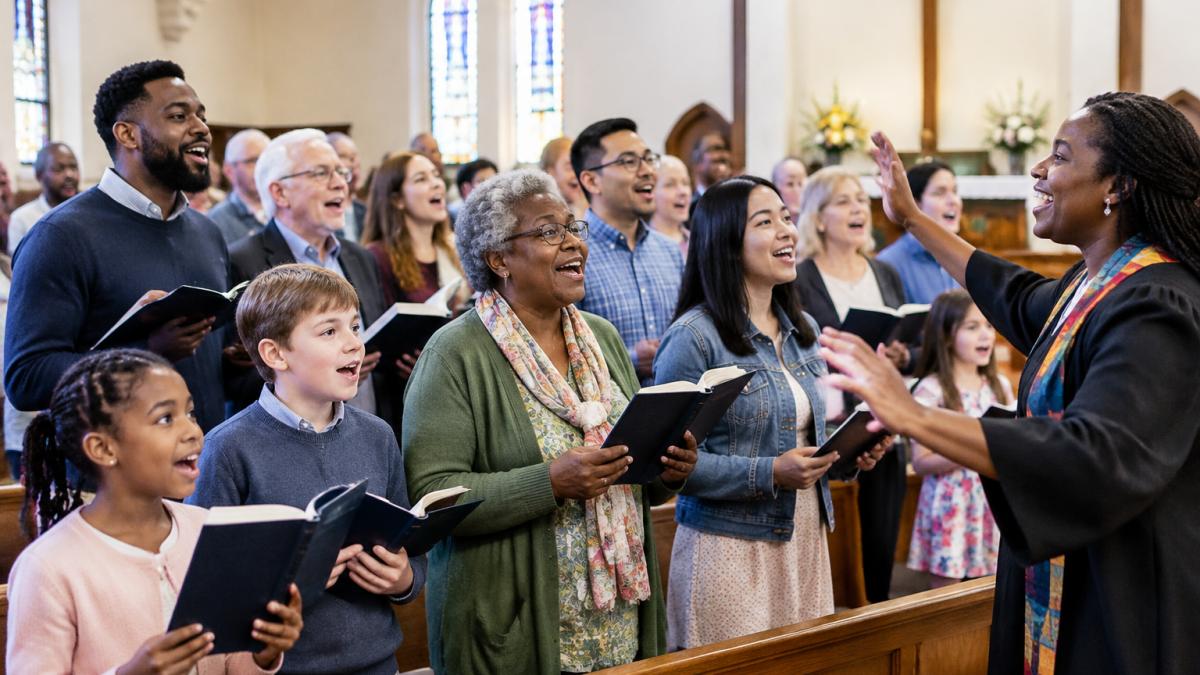
Building that program starts with three moves. First, audit who is currently on the stage and who is missing. Second, choose songs with ranges and refrains that untrained singers can follow. Third, make space for members who are deaf, who speak another first language, or who need sensory-friendly environments.
This is where Let Her Sing! does its work. The book argues that the heart of worship is found in community and collective musical engagement, and it offers a framework for building a program with a wide-open door. For more practical starting points, see these inclusive worship ideas for churches.
Watch out: the most common mistake is adding one "inclusive" song and calling the job done. Inclusion is a foundation, not a feature.
Congregational Singing Ideas That Get Every Voice Involved
Congregational singing ideas work best when they lower the barrier to joining in. A few that churches find effective:
- Teach a new song by ear, one line at a time, before the service starts
- Print full texts rather than projecting only lyrics, for readers and lip-readers
- Keep keys low enough for untrained voices
- Invite the congregation to lead a verse on their own
- Use simple rounds and refrains that need no rehearsal
For a focused look at this, our article on how to encourage congregational singing in 2026 goes deeper. The point is not perfect music. It is participation.
Song Discovery and Rehearsal Tools for Worship Teams
Song discovery and rehearsal tools help teams learn music together across instruments and vocals, but the 2026 landscape is crowded and not every tool fits every church. A useful way to sort them is by what they actually solve: finding songs, learning parts, or coordinating rehearsals.
For song discovery, leaders often start with streaming playlists and curated roundups. These are useful for seeing what is circulating, but they rarely tell you whether a song will work for your congregation's range, literacy, or theological emphasis.
For part-learning and rehearsal, many churches use rehearsal platforms and chart services. Licensing terms differ across providers, so check the fine print before you build a Sunday around any of them.
A common pattern is to mix one discovery source with one rehearsal resource, and to add a backing-track service only if the church uses tracks at all.
What most guides miss: a rehearsal tool is only as good as the rehearsal culture around it. A team that never practices together will not be saved by better tutorials. Before you buy another subscription, ask whether your team has a consistent midweek rehearsal, whether parts are assigned in advance, and whether volunteers can access materials on their phones. If the answer is no, fix the culture first, then choose the tool that supports it. For teams comparing platforms, our roundup of Worship Together alternatives for churches weighs options by size and workflow.
How to Choose Your Church's Worship Resources for 2026
Choosing worship resources comes down to matching the tool to your congregation's actual needs, not the loudest recommendation. Start with your size, denomination, and worship style, then narrow by accessibility, licensing, and workflow fit.
A short decision path:
- Name the gap: participation, planning, or rehearsal
- Check accessibility and licensing terms first
- Confirm it fits your current planning software
- Ask what the ongoing time and cost commitment looks like
- Pilot it for one month with a small team
If you are at the choosing stage, our overview of what worship ministry resources churches need gives you a clear checklist. And remember the leadership piece: a resource that does not equip your volunteers in service to one another will not last.
Start Building Your Inclusive Worship Plan This Week
The best worship resources for in 2026 will not build an inclusive program for you. They give you the raw material, and the work of stewardship is yours: choosing songs that welcome every voice, planning services that hold together, and leading in service to the people in front of you.
Let Her Sing! exists to encourage exactly that. The book invites every voice into the life and worship of the congregation, and it makes the case that community is where the heart of worship is found. If you want a resource that treats inclusion as the foundation rather than an add-on, start there.
Get started with Let Her Sing! and give every voice in your congregation a place to sing.
The challenge is not finding more worship material. It is building a program where each person's music has a home. Let Her Sing! offers a framework for that work, with a focus on community-based worship and advocacy for inclusive congregational singing. Read it with your team, then plan your first wide-open-door Sunday.
Frequently Asked Questions
What are the best worship planning resources for churches in 2026?
The strongest worship planning resources in 2026 combine scheduling, song selection, and team communication. Let Her Sing! focuses on congregational participation rather than performance, and it can be a helpful companion to whichever planning tools your church chooses.
How can a church make its music program more inclusive?
Start by auditing who is currently on stage and who is missing. Inclusive church music means creating entry points for older members, children, people with disabilities, and non-English speakers. Practical steps include printing large-print lyrics and scheduling songs with simple repeated refrains. Let Her Sing! encourages building these foundations and emphasizes leadership in service to every voice.
What are all-age worship resources and why do they matter?
All-age worship resources are materials designed so children, youth, and adults can participate together rather than splitting into separate programs. They include songs with simple choruses, visual aids, and intergenerational liturgies. These resources matter because they help build community through shared singing. When a seven-year-old and an eighty-year-old sing the same refrain, the church becomes a community rather than an audience.
How do I plan a worship service around a lectionary reading?
Begin with the Revised Common Lectionary texts for the date, then choose songs that echo the theme of the reading. Keep the service flow simple: gather, proclaim, respond, and send. Let Her Sing! encourages planners to value congregational singing as a form of response to the community's worship.
What tools can help a church worship team prepare together?
Churches often combine a planning tool, a chord or chart resource, and a shared rehearsal plan. Let Her Sing! encourages a clear expectation that every player supports the ministry, not just the music.