 blog
Worship Together Alternatives for Churches in 2026
Table of Contents
- Why Churches Are Looking at Worship Together Alternatives
- What to Compare in Church Worship Planning Resources
- Worship Together Alternatives Worth Knowing
- Worship With Limited Musicians: Options That Keep the Congregation Singing
- Blended Worship Service Ideas That Hold Both Hymns and New Songs
- Shared Worship Ministry: When Churches Pool Their People
- Choosing by Church Size and Tradition
- Conclusion
- Frequently Asked Questions
Last Updated: October 13, 2026
Why Churches Are Looking at Worship Together Alternatives
At Let Her Sing!, we believe the heart of worship is found in community and collective musical engagement.
Most worship planning resources sell access to charts, tracks, and lyrics. But access is not participation.
research on congregational singing and community wellbeing suggests that group singing builds social bonds in ways that passive listening does not.
So the real question is not "which library has more songs?" but "which resource gets more of my congregation singing?"
What to Compare in Church Worship Planning Resources
Compare four things before you commit: song library depth, licensing coverage, presentation tools, and how the resource works when your tech fails.
Song Library Depth and Licensing Coverage
A deep library means little if the songs are unsingable for your people. Look for range, not volume.
Ask these questions:
- Does the catalog include hymns as well as contemporary worship songs?
- Are chord charts available in keys your congregation can actually reach?
- Does the license cover streaming, recording, and printing?
Licensing trips up more churches than any other factor. A library that ignores copyright reporting creates risk you did not plan for.
Presentation Software, Audio, and Offline Use
Your presentation software must talk to your song source, or your volunteer spends Saturday night retyping lyrics.
Check these points:
- Does it export directly to your presentation software?
- Are backing tracks and split tracks included or sold separately?
- Can you download songs for offline use when the internet drops?
That last one matters more than vendors admit. Many smaller churches run on whatever hardware is already in the building.
| What to Check | Why It Matters | Red Flag |
|---|---|---|
| Song range | Keeps all ages singing | Only new contemporary songs |
| Licensing | Avoids copyright risk | No reporting tools |
| Export options | Saves volunteer hours | Manual lyric entry |
| Offline access | Survives bad Wi-Fi | Streaming only |
| Device support | Works with what you own | Requires new hardware |
Worship Together Alternatives Worth Knowing
Worship together alternatives fall into two groups: platforms that sell songs and resources that build participation. They solve different problems, and most healthy churches use one of each.
Song Library and Chart Platforms
Chart and track platforms do one job well. They hand your team accurate music fast. If your praise band needs a chord chart in a specific key by Thursday, these tools deliver.
What they do well:
- Large catalogs of worship songs and hymns
- Chord charts, lead sheets, and lyric files
- Backing tracks and split tracks for smaller teams
Where they fall short: they assume you already have musicians and a plan. A church with three volunteers and no music director gets files, not direction.
A practical way to compare them is on five axes:
| What to Compare | Why It Matters | What to Watch For |
|---|---|---|
| Song range | Keeps all ages singing | Catalogs heavy on new contemporary songs only |
| Licensing and reporting | Avoids copyright risk | No built-in usage reporting for your license |
| Export and integration | Saves volunteer hours | Manual lyric re-entry into presentation software |
| Offline access | Survives bad Wi-Fi | Streaming-only playback |
| Device support | Works with what you own | Requires new hardware or a paid add-on |
Licensing is the axis most churches underestimate. In the United States, most congregations cover congregational singing and projection through a church copyright license, and many cover streaming and recording through a separate streaming license.
Inclusive, Community-First Resources
A different kind of resource starts with people, not songs. This is where Let Her Sing! sits: a call to action for the church, inviting every voice into the life and worship of the congregation.
Instead of asking "what should we sing," it asks "who is not singing, and why?" That shift changes your song selection, your stage, and your rehearsal.
What this approach offers:
- A framework for building an inclusive music program
- Guidance on leadership as service to one another
- Encouragement for pastors, directors, and volunteers
The honest limitation: it is not a song database.
How to Compare Them Side by Side
Put the two categories in the same frame and the choice gets simpler:
| Question | Song Library Platform | Community-First Resource |
|---|---|---|
| What it gives you | Files, charts, tracks | A framework for participation |
| Who it serves first | The band and tech team | The congregation |
| Best when | You have musicians and need music fast | You have music but few voices |
| Weak when | You have no plan or leader | You need charts tonight |
| Typical pairing | Works alone | Works best alongside a chart platform |
Migrating Without Losing Your Team
Switching tools is where good intentions die. A short migration plan keeps volunteers from burning out:
- Inventory what you actually use. List the songs your congregation already knows by heart. That list, not the catalog, is your starting point.
- Export your song lists and service plans from the old tool before you cancel anything.
- Rebuild your top 20 songs first. Most churches sing a small core repeatedly; get those right before chasing the long tail.
- Train one volunteer deeply, not everyone shallowly. One confident operator beats five hesitant ones.
- Run both tools in parallel for two or three Sundays. Compare them live before you commit.
- Test the failure case. Unplug the internet during rehearsal and see what still works.
Worship With Limited Musicians: Options That Keep the Congregation Singing
Limited musicians is the normal state of most churches, not the exception. The goal is not to hide the shortage but to lead in a way that carries the room.
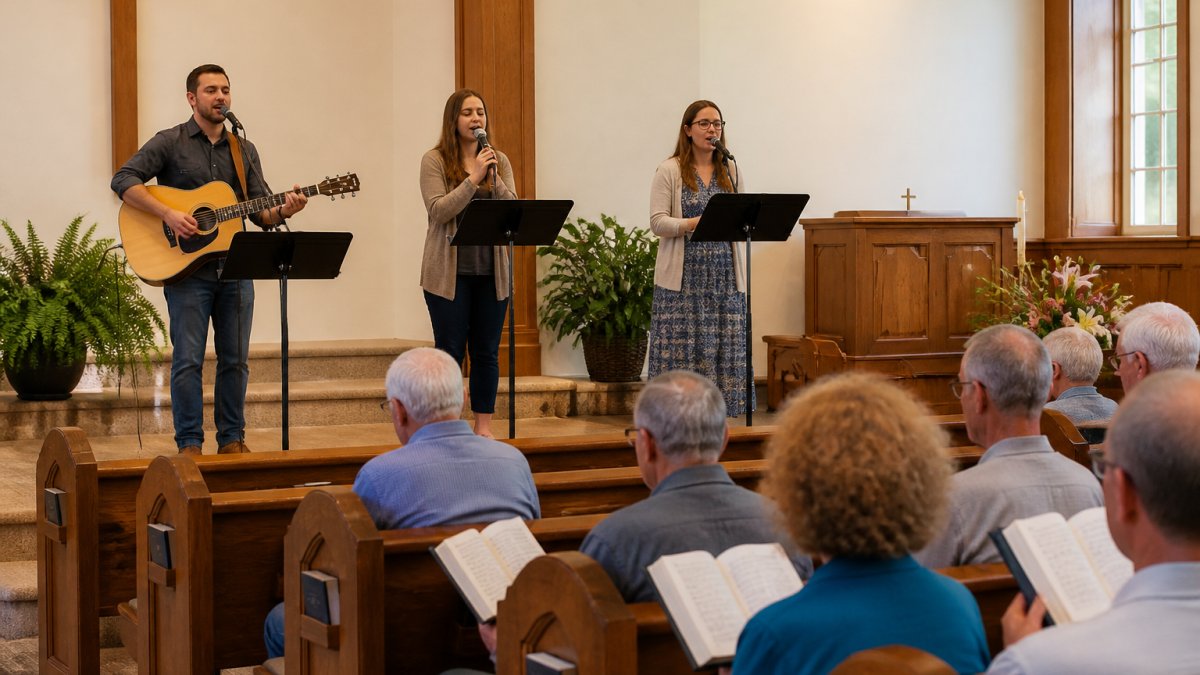
Practical options that work:
- Lead from the piano or guitar. One strong instrument plus a clear voice beats a thin full band.
- Use backing tracks. They fill space your team cannot cover.
- Choose singable songs. Familiar melodies carry a room with no rehearsal.
- Teach the song. Sing the refrain once, then invite the congregation in.
- Recruit from the pews. Someone in your third row plays. Ask them.
The mistake is chasing a sound you cannot staff, programming complex arrangements for a team of two. Simplify. Let the congregation be the choir.
How to Choose Between a Live Team and Tracks
Tracks and live musicians are not rivals. They solve different problems, and the right answer depends on what your room needs.
| Situation | Better Choice | Why |
|---|---|---|
| One strong instrumentalist | Live | A single clear instrument leads better than a track |
| No instrumentalist at all | Tracks | Keeps the melody present for the congregation |
| Team of two or three | Hybrid | Live leads, tracks fill the missing parts |
| Unreliable internet | Live or downloaded tracks | Streaming fails when the Wi-Fi does |
| Volunteer turnover | Tracks plus simple charts | Less rehearsal dependency |
A common pattern is the hybrid: one live instrument and voice leading, with a track underneath for bass, drums, or pads.
What Actually Keeps a Congregation Singing
Three mechanisms do most of the work, and none require more musicians:
- Key. If the melody sits above the congregation's comfortable range, people stop. Most congregations sing comfortably in a range that a typical untrained voice can reach without strain. Transpose down when in doubt.
- Familiarity. Repetition is the secret nobody markets. A song sung four Sundays in a row becomes a song everyone can sing. New music needs time to become familiar music.
- Leadership clarity. One confident voice, audible above the instruments, gives the room permission to join. If the congregation cannot hear the melody, they will not follow it.
Accessibility and Offline Reality
Inclusion is not marketing language. It is planning. For churches with deaf members, autistic members, or multiple language groups, the steps are simple:
- Print lyrics and keep them large enough to read from the back row.
- Use clear, high-contrast visuals and avoid fast-moving text.
- Keep the melody simple enough to follow by ear.
Offline use matters here too. Download your tracks and charts before Sunday; a service that depends on live streaming will fail the week the internet does.
Blended Worship Service Ideas That Hold Both Hymns and New Songs
Blended worship works when hymns and new songs share a theme, not just a slot. Random mixing feels disjointed; thematic pairing feels intentional.
Try these blended worship service ideas:
- Open with a hymn the older members know by heart.
- Follow it with a contemporary song on the same theme.
- Set a modern chorus inside a traditional hymn as a bridge.
Repetition is the secret nobody markets. A song sung four Sundays in a row becomes a song everyone can sing.
Coordinate with your pastor here. When songs match the service message, the whole hour holds together; song and sermon should tell one story.
Shared Worship Ministry: When Churches Pool Their People
Shared worship ministry lets two or three small churches combine musicians, choirs, and resources for services and events, one of the most practical answers to a thin roster.
How to make it work:
- Agree on a shared song list both congregations know.
- Rotate the host church so no one feels like a guest.
- Pool volunteers for choir and praise band.
The hard part is not logistics but identity. Each church wants its own sound. Decide early that the shared ministry serves all the congregations, not one.
Leadership here is service. Someone has to schedule, call, and follow up. That person is doing ministry, not admin.
Choosing by Church Size and Tradition
Match the resource to your reality. A 40-person rural church and a 400-person suburban church need different tools.
| Church Profile | Priority | Best Fit |
|---|---|---|
| Small, limited musicians | Singable songs, tracks | Chart platform plus participation guide |
| Traditional, change-resistant | Hymns, gradual blending | Blended worship plan |
| Contemporary, growing | New songs, fast charts | Song library platform |
| Multi-church, shared team | Coordination, shared lists | Shared worship ministry model |
| Mixed ages and languages | Inclusion, accessibility | Community-first resource |
Traditional churches do not need to overhaul everything. Start with one hymn and one new song each month. Let the change be slow and welcome.
Conclusion
The hardest part of worship planning is not finding songs. It is building a room where every voice feels welcome to sing. That takes leadership, patience, and a plan.
Let Her Sing! exists for exactly this work, focusing on community-based worship and advocating for inclusive congregational singing. It helps you see the church as the place for your music, and your church as a place for everyone's music.
If you want more voices in the room this year, start there.
Frequently Asked Questions
What are the main alternatives to Worship Together for churches?
Most churches choose between song library and chart platforms, presentation and planning software, and community-focused resources built around congregational participation. Song platforms supply lyrics, chord charts, and arrangements. Planning tools handle service flow, team scheduling, and rehearsal. Community-first resources, such as the book Let Her Sing!, focus on bringing every voice into worship rather than adding more songs. Many churches use one library tool plus one participation resource rather than replacing everything at once.
How can a church plan worship music with limited musicians?
Start with songs the congregation already knows, because a confident room carries the sound. One strong vocalist with a guitar or keyboard can lead a full service if the song selection is singable. Backing tracks and split tracks fill in parts your team cannot cover, and recorded arrangements let you rehearse at home. Rotate volunteers so no one burns out, and keep arrangements simple enough that a substitute can step in on short notice.
What resources help churches blend contemporary and traditional music?
Blended worship works best when hymns and contemporary songs share the same key, tempo range, and theme. Choose a hymn as the anchor, then place a modern song beside it that repeats the same message. Chord charts that include hymn texts and modern arrangements help your team move between styles without extra rehearsal. A shared song list, marked with keys and tempos, keeps both the praise band and the choir working from the same plan.
How can churches build a shared worship ministry across different musical styles?
Shared worship ministry begins with leadership in service to each other. Invite choir members, praise band players, and congregational singers into the same planning conversation, and let each group host a song once a month. Pair an experienced musician with a newer volunteer for rehearsal. When the stage reflects the whole congregation, including older members and younger voices, more people sing from the pews. The goal is participation, not a perfect performance.
Every church has someone standing silent in the back row, mouth closed, waiting to be invited in. Changing that takes more than a new subscription. It takes a vision for worship where every voice has a place. Let Her Sing! offers that vision through its focus on community-based worship and its advocacy for inclusive congregational singing. Get started with Let Her Sing! and build a music ministry where the whole congregation sings.