 blog
Worship Together vs PraiseCharts: 2026 Comparison
Table of Contents
- Worship Together vs PraiseCharts: What Each Platform Actually Offers
- Side-by-Side Comparison: Charts, Formats, and Catalog
- PraiseCharts Planning Center Integration and Workflow
- PraiseCharts Enhancement Tracks: When They Help and When They Don't
- How to Choose Worship Songs for Church Use With Either Platform
- Worship Team Song Preparation: A Practical Workflow
- Which Platform Fits Your Church? A Decision Framework
- Frequently Asked Questions
Last Updated: October 20, 2026
Worship Together vs PraiseCharts: What Each Platform Actually Offers
The worship together vs praisecharts comparison comes down to a single question: what does your team need on Sunday morning? Both platforms sell worship music resources, but they were built for different buyers. This guide walks through catalogs, formats, licensing, and workflow so you can pick with your eyes open. Below, we show exactly how each platform behaves in a real rehearsal week, and where both fall short of what a congregation actually needs.
Worship Together is a worship music resource platform centered on song charts, arrangements, and training content for worship teams. It leans toward contemporary worship repertoire and the modern praise band.
PraiseCharts is a downloadable music resource service that sells charts, orchestrations, choir parts, and accompaniment tracks across a broad catalog of contemporary worship songs and hymns.
Here is where most churches get stuck: they treat the choice as a shopping decision. It is a stewardship decision. The right platform is the one your actual players can use, not the one with the biggest catalog.
Worship Together at a Glance
Worship Together works best for teams that want a curated, contemporary-leaning library with a low learning curve. Its strength is familiarity: song charts and lead sheets in keys worship teams already sing, plus training material aimed at volunteers rather than professionals.
Its limits show up when a church needs full orchestrations, printed choral collections, or deep planning-tool integration. A blended worship service pulling from hymns and choir repertoire will often find the catalog thinner than expected.
PraiseCharts at a Glance
PraiseCharts is the heavier tool. It covers a wide catalog of worship songs, hymns, and seasonal material, with arrangements across many instrumentations, from simple chord charts to full orchestration and choir parts.
The trade-off is complexity. PraiseCharts rewards teams that know what they want and can navigate arrangement options. A small volunteer team can get lost in the choices.
Side-by-Side Comparison: Charts, Formats, and Catalog
Neither platform is better in the abstract. The differences cluster around catalog breadth, format depth, and how much planning structure you need. Here is a more concrete breakdown of what each service actually provides.
| Feature | Worship Together | PraiseCharts |
|---|---|---|
| Primary focus | Contemporary worship charts and training | Broad catalog across styles, with heavy arrangement options |
| Chart formats | Chord charts, lead sheets, lyric sheets | Chord charts, lead sheets, vocal parts, full scores, orchestrations |
| Choir and orchestral parts | Limited or not a core offering | Extensive: choir parts, orchestration, individual instrument parts |
| Arrangement variety | Curated, often one primary arrangement per song | Multiple arrangements and keys per song |
| Planning tool integration | Basic or limited | Strong integration with common service planning tools |
| Search and browse | Simpler, curated discovery | More filters and metadata, but steeper learning curve |
| Best for | Small to mid-size teams wanting a curated library | Teams with choir, orchestra, or complex arrangements |
Catalog and searchability. PraiseCharts generally offers a wider catalog that includes hymns, seasonal material, and multiple arrangements per song. Worship Together leans toward a curated contemporary repertoire. In practice, the question is not which catalog is larger but whether your shortlisted songs exist in the format your players need. A common pattern is that a song may be available as a chord chart on both platforms, but only one may offer a full orchestration or a specific choir arrangement.
File formats and workflow. Both services provide downloadable charts, but the depth of formats differs. PraiseCharts is more likely to offer separate parts for each instrument, vocal parts, and full scores. Worship Together tends to focus on chord charts and lead sheets. If your team uses a planning tool, check whether the platform integrates directly or whether you will be downloading and uploading files manually.
Chart accuracy and usability. Neither platform guarantees a perfect match to the recorded version. A transparent approach is to pick one song your team knows well and download the chart from each service. Compare the chord voicings, the melody line, the layout, and the transposition options. This sample-song test will tell you more about usability than any feature list.
The pattern is clear. Worship Together gives you fewer options, chosen for you. PraiseCharts gives you more options and expects you to choose. The right choice depends on how much choice your team can handle.
PraiseCharts Planning Center Integration and Workflow
PraiseCharts Planning Center integration is where the platform earns its keep for organized teams. Charts and arrangements can be pulled into your existing service planning workflow, so the team sees keys, parts, and files in one place instead of scattered emails and printed folders.
That matters more than it sounds. Song preparation is a coordination problem before it is a musical one. When the chart lives in the same place as the setlist, volunteers show up knowing what they are playing.
Worship Together handles this less deeply. If your church already runs service planning software, PraiseCharts fits the existing structure with less friction.
PraiseCharts Enhancement Tracks: When They Help and When They Don't
PraiseCharts enhancement tracks are supplemental audio and arrangement resources designed to support a song beyond the basic chart. They help most when a team is small, when an instrument is missing, or when a song needs a fuller sound than the room can produce live.
They help less when they replace musicianship. A track that carries the congregation while the team follows along is different from a track that plays while the team disengages. The first supports worship. The second quietly teaches your volunteers that showing up is optional.
Use them as scaffolding, not as a substitute for the people on your stage.
How to Choose Worship Songs for Church Use With Either Platform
Learning how to choose worship songs for church use is a skill neither platform teaches. Both will sell you charts. Neither knows your congregation.
Start with the room, not the catalog. Ask three questions before you download anything:
- Can the congregation sing this without a rehearsal?
- Does the melody sit in a range that untrained voices can reach?
- Does the lyric say something your church actually believes and lives?
A song that is easy for the band but unreachable for the congregation is a performance, not worship. This is the mistake of thinking that the church music program is about music. It is about the people singing.
Hymnary.org's research on congregational song repertoire is a useful reference for checking a song's history and common keys before you commit.
Worship Team Song Preparation: A Practical Workflow
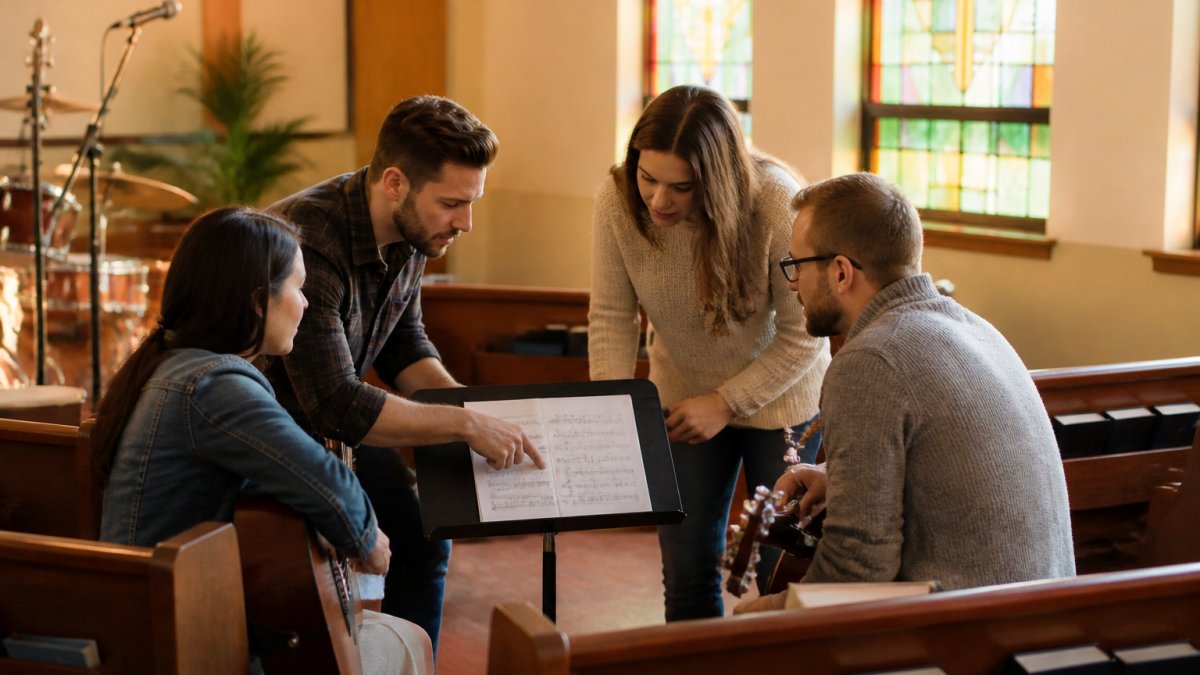
Worship team song preparation works best as a repeatable weekly rhythm, not a scramble on Saturday night. Here is a recommended sequence, and it works with either platform.
- Confirm the setlist by midweek. Lock keys before anyone downloads a chart.
- Assign parts by person, not by instrument. Name who plays what.
- Distribute charts and tracks together. Players should hear the arrangement before rehearsal.
- Set the key once and stop changing it. Transposition confusion wastes rehearsal time.
- Rehearse the transitions, not just the songs. Most Sunday stumbles happen between songs.
- Send a short recording after rehearsal. Volunteers forget; a recording remembers.
Which Platform Fits Your Church? A Decision Framework
Which platform fits depends on your ensemble, your planning habits, and your budget for volunteer time. Use this framework, organized by church size, skill level, and worship style.
By church size and ensemble:
- Solo musician or small team (1-3 players): Worship Together's curated chord charts and lead sheets are often sufficient. PraiseCharts can work, but the array of options may be overwhelming.
- Mid-size team (4-7 players) with contemporary focus: Both platforms can serve, but check whether the songs you sing are available in the keys and arrangements your team uses. Worship Together may be simpler; PraiseCharts may offer more flexibility.
- Large team with choir or orchestra: PraiseCharts is the stronger fit because of its choir parts, orchestrations, and individual instrument parts.
- Blended worship (hymns and contemporary): PraiseCharts generally has broader coverage of hymns and seasonal material. Worship Together may be thinner in traditional repertoire.
By skill level:
- Volunteer teams with limited rehearsal time: Worship Together's curated approach reduces decision fatigue. PraiseCharts requires more planning to select the right arrangement.
- Teams with a music director or experienced leader: PraiseCharts rewards those who can navigate multiple arrangements and customize parts.
By worship style:
- Contemporary praise band: Both platforms work, but Worship Together leans contemporary.
- Traditional or choral: PraiseCharts is more likely to have the choral and orchestral resources you need.
Licensing and usage rights: Neither platform's charts automatically grant you the right to reproduce or display lyrics. Churches typically need a separate license (such as CCLI) for projection and streaming. Before you commit, verify what each platform's terms allow for your specific use, printing, projection, recording, and streaming. This is a common gap in comparisons, and it matters for stewardship.
Recommendations:
- Choose Worship Together if your team is small to mid-size, contemporary-leaning, and wants a curated library with a gentle learning curve.
- Choose PraiseCharts if you run a choir, orchestra, or larger ensemble and need multiple arrangements, full scores, and planning-tool integration.
- Use both if your ministry spans contemporary worship and traditional choral material.
- Choose neither as your only resource if your goal is congregational participation. Charts support the musicians. They do not build the culture.
That last point is the one we keep coming back to at Let Her Sing!. A platform can give you every chart in the catalog and still leave your congregation silent. The work of building a wide-open-door music program, where every voice has a place, is leadership work. It is the subject of our book, Let Her Sing! on Amazon, and it is the conversation we want to have with worship pastors.
Frequently Asked Questions
What is the difference between Worship Together and PraiseCharts?
Worship Together centers on chord charts, lead sheets, and curated worship song resources tied to a modern worship catalog, with a simpler library-style experience. PraiseCharts goes wider: it offers arrangements for praise bands, choirs, and orchestras, plus transposition tools, enhancement tracks, and Planning Center integration. In short, Worship Together suits teams that want straightforward charts fast, while PraiseCharts suits teams that need multiple instrumentation options and deeper planning workflow support.
Can PraiseCharts integrate with Planning Center?
Yes. PraiseCharts offers a Planning Center integration that lets you pull chart and arrangement selections into your service plans, so your team sees the right keys and parts alongside the order of service. For worship leaders already building setlists in Planning Center, this removes a step of manual downloading and re-uploading. Check the current integration details on PraiseCharts directly, since features and supported formats can change.
How do worship teams use PraiseCharts enhancement tracks?
Enhancement tracks are supplementary audio stems, such as pads, loops, or missing instrument parts, that fill out a live band's sound. Teams use them when a song calls for strings, synth textures, or a specific instrumental hook the church band can't cover live. They work best as support, not a replacement for your players. Decide track by track whether the addition serves the congregation's singing or distracts from it.
How should a church choose worship resources for its congregation?
Start with who is actually singing. Match chart formats to your team's reading ability, favor keys the congregation can reach, and pick songs that fit your ministry's mission rather than the latest release. Then evaluate the platform: catalog depth, transposition, file formats, and planning integrations all matter. A resource only earns its place if it helps more voices join in, not just the stage.