 How-to
Worship Planning for Diverse Congregations: A How-To Guide
Table of Contents
- Start With Listening: Worship Planning for Diverse Congregations
- Your Worship Service Planning Checklist: A Repeatable Workflow
- Multilingual Worship Service Practical Tips for Real Churches
- Accessible Church Worship Ideas for Every Body and Mind
- Diverse Worship Music Examples That Blend Traditions Without Flattening Them
- Shared Decision-Making: Who Sits at the Worship Planning Table
- How to Know It's Working: Feedback and Participation Measures
- Common Mistakes in Worship Planning for Diverse Congregations
- Frequently Asked Questions
Last Updated: October 16, 2026
Start With Listening: Worship Planning for Diverse Congregations
Worship planning for diverse congregations begins with listening, not with a song list.
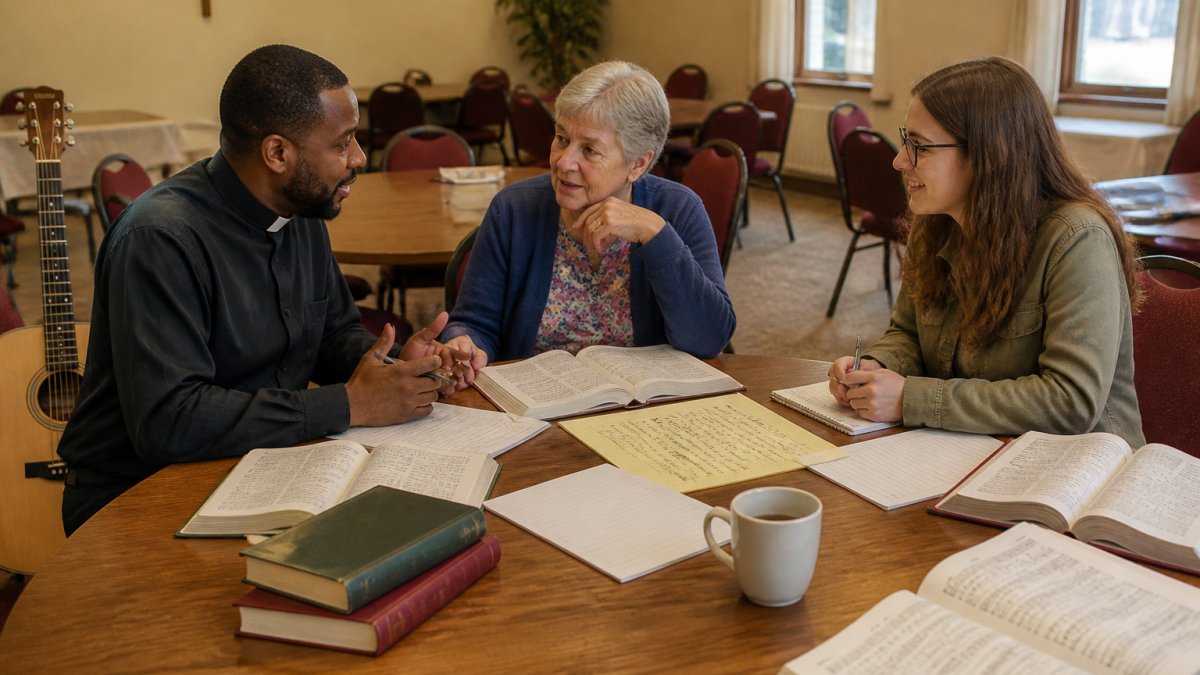
The old model was simple. One music director picked the songs, the choir rehearsed them, and the congregation watched.
Think about who is missing from your average Sunday service. The grandmother who grew up on hymns.
A common mistake is treating diversity as a music problem. It is not. It is a listening problem.
Your Worship Service Planning Checklist: A Repeatable Workflow
A worship service planning checklist turns good intentions into a repeatable rhythm. It keeps one person from carrying the whole load and gives every voice a predictable place at the table.
Here is the workflow we recommend:
- Gather the planning team (pastor, music leader, lay volunteers, at least one member from a different age group)
- Read the scripture and sermon theme together out loud
- Name the cultures, languages, and abilities present in your congregation
That last step is the one most churches skip. Do not skip it.
The Planning Rhythm: Six Weeks Out to Sunday Morning
Six weeks out, the pastor and music leaders agree on the scripture and preaching theme. Four weeks out, the planning team meets and picks the worship set. Three weeks out, you confirm your musicians, readers, and volunteers. Two weeks out, you send the order of worship to everyone involved. One week out, you rehearse. Sunday morning, you worship and let go.
| Timeline | Task | Who Leads |
|---|---|---|
| Six weeks out | Confirm scripture and theme | Pastor and music leader |
| Four weeks out | Select songs and service elements | Planning team |
| Three weeks out | Confirm volunteers and readers | Lay leaders |
| Two weeks out | Share the order of worship | Worship leader |
| One week out | Rehearsal | Music director |
| After Sunday | Debrief and feedback | Whole team |
Multilingual Worship Service Practical Tips for Real Churches
Multilingual worship service practical tips start with one rule: never translate as an afterthought. If a Spanish-speaking member only hears their language in a rushed postscript, they learn that their voice is optional.
A few approaches that work:
- Print the order of worship in every language your congregation speaks
- Teach one song in two languages and sing it together, verse by verse
- Invite bilingual members to lead prayers in their first language
You do not need fluency in every language to lead well. You need humility and a plan. Ask bilingual members what they would like to hear, and then follow through.
Accessible Church Worship Ideas for Every Body and Mind
Accessible church worship ideas begin with a simple question: can everyone in this room fully take part?
Consider these practical steps:
- Offer large-print bulletins and lyric sheets
- Keep aisles clear and seating flexible for wheelchairs and walkers
- Lower the volume during loud songs, or offer a quiet room
- Provide a printed order of worship for members who find surprises hard
Many congregations find that changes made for one group help everyone. Clear print helps tired eyes. Quieter music helps older ears.
What most guides miss is that access is not a project with an end date. It is a habit. Review it every season.
Diverse Worship Music Examples That Blend Traditions Without Flattening Them
Diverse worship music examples work best when each tradition keeps its own shape. Blending does not mean sanding every song down until it sounds the same. It means placing songs side by side with enough context that each one still carries its own weight.
Most guides stop at the pairing. The harder work is the framework behind the pairing. Here is the one we recommend.
A Four-Step Framework for Respectful Blending
- Name the source. Before a song enters your service, identify where it comes from, the tradition, the region, the era, and the community that shaped it. Write it down. If you cannot name it, you are not ready to use it.
- Choose the right contributor. A song from a specific tradition is best introduced by someone who carries that tradition. A gospel arrangement lands differently when a member who grew up in that tradition leads it. If no one in your congregation carries it, ask whether you should use it at all this season.
- Explain before you sing. A short spoken introduction, thirty to sixty seconds, tells the congregation what they are about to hear and why it matters. A song without its story becomes decoration. A song with its story becomes a gift.
- Keep the arrangement honest. Do not force a hymn into a pop structure or a spiritual into a contemporary chorus just to make it fit. Let each piece keep its own rhythm, its own phrasing, its own ending.
Pairings That Work
Try combinations like these, and notice how each one keeps both traditions intact:
- A traditional hymn followed by a contemporary chorus on the same theme, with a spoken bridge explaining the shared text
- A gospel arrangement of a familiar hymn, sung by the choir, introduced by a member who grew up singing it
- A Spanish-language chorus taught to the whole congregation, verse by verse, over two or three Sundays
- A spiritual or folk song from another culture, introduced with its story and its origin
What to Avoid
- Do not stack three traditions into one song. That flattens all three.
- Do not use a tradition's music only on its heritage Sunday. That turns it into a performance for visitors.
- Do not ask a single member to represent an entire culture. One person is not a culture.
- Do not add a new tradition without explaining it. Unexplained music reads as decoration.
If your church already uses a song library, you know the limits. A library gives you charts and lyrics. It does not give you a plan for weaving traditions together. That work belongs to your team, and it is worth doing slowly.
Shared Decision-Making: Who Sits at the Worship Planning Table
Shared decision-making means the people affected by worship decisions help make them. That sounds obvious. It rarely happens. And when it does happen badly, it becomes tokenism, a seat at the table with no voice, no authority, and no follow-through.
Who Belongs at the Table
A healthy planning table includes:
- The pastor, who guards the ministry and mission
- The music director or worship leader
- At least one choir or worship team member
- Two or three lay volunteers from different age groups
How to Avoid Tokenism
Inviting someone to the table is not the same as sharing power with them. Four practices separate real shared decision-making from a photo opportunity:
- Give each member a decision they own. Not a topic they advise on, a decision they make. The person who speaks Spanish decides which Spanish-language songs enter the rotation. The person who uses a wheelchair decides which accessibility changes come first. Ownership builds commitment faster than invitations do.
- Rotate members each season. A table that never changes becomes a closed circle. Rotate at least one seat every quarter so the table stays porous.
- Pay attention to who speaks first. If the same two people open every meeting, the table is not shared. Ask the newest member to speak first on the first agenda item.
- End every meeting with one question. Who was not in this room, and what did we miss? Write the answer down. Follow up before the next meeting.
A Simple Decision Rule
When the table cannot agree, ask: does this decision move us closer to a service where every person present can take part? If the answer is no, the decision is not finished.
Churches should not fill their stages with players who do not support the ministry or mission. That is not about talent. It is about alignment. A gifted musician who ignores the congregation's needs is not helping the service.
How to Know It's Working: Feedback and Participation Measures
You cannot improve what you never measure. The good news is that the measures that matter are simple and free.
Watch for these signals:
- How many people sing, and how many stay silent
- Whether new faces appear in the choir or worship team
- Whether members from different age groups serve together
- Whether feedback comes from more than the same three people
Ask three short questions after the service, once a season:
- Did you feel able to take part today?
- Was there a moment that felt like it was for you?
- What would help you sing or pray more fully next time?
Then act on the answers. Feedback that changes nothing teaches people to stop giving it.
Common Mistakes in Worship Planning for Diverse Congregations
The biggest mistake is treating diversity as a checkbox. One Spanish song in December does not make a congregation inclusive.
Other common errors:
- Planning in a closed room with the same four people every season
- Choosing only songs the worship team enjoys
- Adding a new tradition without explaining it
- Measuring success by attendance alone
The church music program was never really about music. It is about people, and about whether every voice has a place.
If you want a deeper foundation for this work, Let Her Sing! gathers these ideas into one encouraging resource for pastors, music leaders, and volunteers.
Frequently Asked Questions
How do you plan a worship service for a diverse congregation?
Start by listening before you schedule. Ask members across ages, languages, and abilities what helps them sing and pray. Then build a repeatable worship planning workflow: choose the scripture or theme first, select songs from more than one tradition, assign reading and prayer roles broadly, and rehearse with your volunteers. Review participation after the service and adjust. The goal is not perfect music but a service where every person can find a place to join in.
What should be on a worship service planning checklist?
A practical worship service planning checklist covers the theme or scripture, song selections from multiple traditions, language needs, accessibility requirements, who leads each service element, rehearsal times, and printed or projected materials. Add a post-service review step so the checklist improves over time. Keep it short enough that a volunteer can run it without you. The checklist exists to protect participation, not to add paperwork.
How can a congregation include multiple languages in worship?
Try one song or refrain in another language each month, with pronunciation help printed or projected. Pair a Spanish verse with an English chorus, or invite a member to lead a prayer in their first language with a translation nearby. Multilingual worship works best when it is regular and shared rather than occasional and performative. Start with the languages already present in your pews, not languages you wish were there.
How do you choose music that encourages congregational participation?
Pick songs the congregation already knows, then teach one new song at a time over several weeks. Favor refrains that are easy to sing without a book, and keep the range comfortable for older voices. Mix hymns, global songs, and contemporary pieces instead of committing to one style. When people know the song, they sing. When they sing, the worship team becomes accompaniment rather than performance.
Building a worship service where every voice truly belongs is slow, patient work, and no single season will finish it. Let Her Sing! exists to help you take the next step, with a focus on community-based worship and advocacy for inclusive congregational singing. If your church is ready to make room for every voice, start with the book and bring your team along. Get started with Let Her Sing! and build a worship life your whole congregation can join.