 How-to
How to Boost Engagement in Multilingual Worship
Last Updated: October 28, 2026
Quick Summary
Boost engagement in multilingual worship by weaving two or more languages into songs, prayers, readings, and spoken parts as a participation strategy, not a translation exercise. Start small with one repeated element everyone can join, such as a bilingual call to worship or a refrain sung in two languages.
- Map every language spoken at home by members, noting reading comfort as well as speaking comfort.
- Show a maximum of two languages per slide and keep line breaks parallel between them.
- Train greeters to offer a welcome in two or three languages, pairing a fluent greeter with a heritage speaker.
- Track one engagement indicator, such as singing volume by language, for a set period.
- Start with one bilingual element and add another later as a repeated refrain.
Table of Contents
- Why Multilingual Worship Engagement Matters
- Bilingual Worship Service Ideas for Every Church
- Multilingual Worship Service Planning: A Step-by-Step Workflow
- Church Service Translation and Interpretation Logistics
- Multilingual Worship Slides and Lyrics That Include Everyone
- Making Worship Welcoming for Visitors and Newcomers
- Measuring Engagement and Gathering Feedback
- Next Steps: Building a Connected Musical Legacy
- Frequently Asked Questions
Why Multilingual Worship Engagement Matters
A congregation that prays, reads, and sings across several languages is not performing diversity. It is practicing belonging.
At Let Her Sing!, we believe the heart of worship is found in community and collective musical engagement. That conviction shapes everything below.
Language is where belonging lives.
Multilingual worship is the practice of weaving two or more languages into the life of a service: songs, prayers, readings, and spoken parts. It is not a translation exercise. It is a participation strategy.
Why does engagement matter so much here?
The work is deliberate.
Bilingual Worship Service Ideas for Every Church
Bilingual worship service ideas can start small and repeat often. You do not need a full second-language service to begin. You need one repeated element that everyone can join.
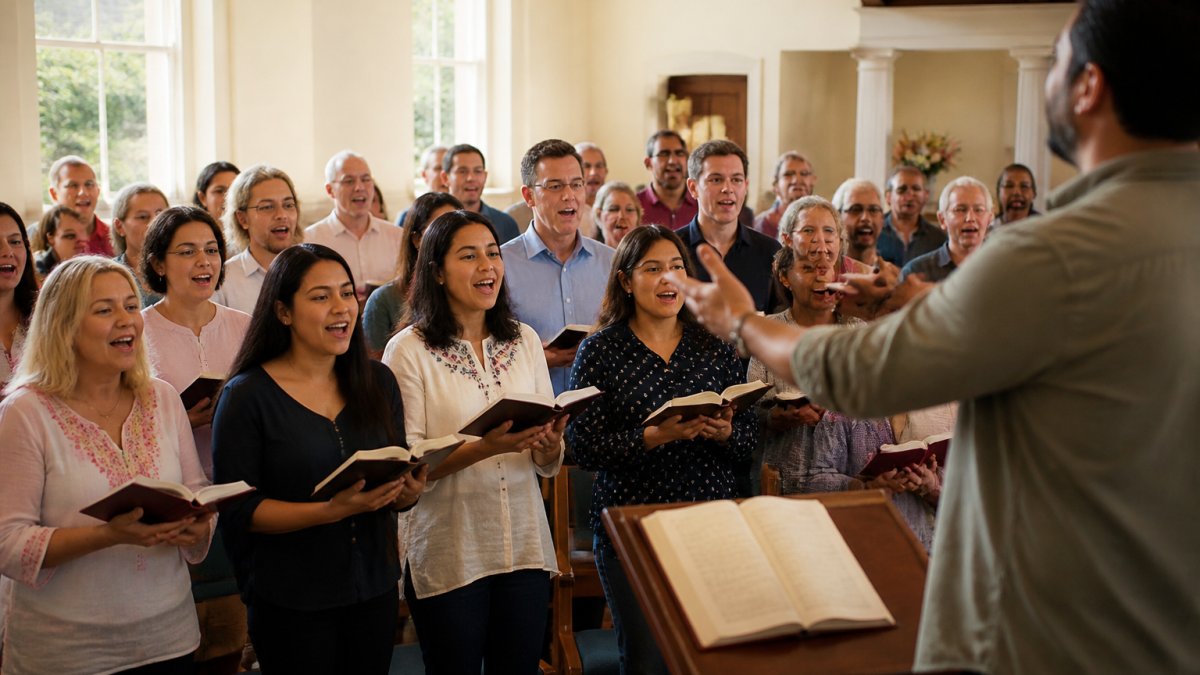
Here are ideas that fit churches of any size:
- A bilingual Call to Worship. One leader opens in English, another answers in Spanish, Korean, or Tagalog. Short lines. Everyone hears both.
- A refrain in two languages. Pick one chorus. Teach it line by line. Sing it in both languages every week for a month.
- The Lord's Prayer in the congregation's languages. Print it side by side. Invite people to pray in whichever version is theirs.
- A rotating scripture reading. One reader per language, one short passage, read back to back.
- A song from the global church. Choose a hymn or chorus already beloved in another culture. Explain it in one sentence before you sing.
- Communion with bilingual words. The words of institution read in two languages, slowly.
The pattern matters more than the polish. For help choosing songs that fit multiple languages, see our guide to worship music for diverse congregations.
Multilingual Worship Service Planning: A Step-by-Step Workflow
Multilingual worship service planning can follow a repeatable workflow: map your congregation, assign languages to each service element, and build a feedback loop that runs every month. For a deeper how-to guide on worship planning for diverse congregations, see our companion article. Plan the whole service on one page, then adjust after each gathering.
Here is one possible workflow, in three steps.
Step 1: Map Your Congregation's Languages
Start with what you actually have, not what you wish you had.
- List every language spoken at home by at least a handful of members.
- Note reading comfort, not just speaking comfort. Some people speak a language but read it slowly.
- Ask which languages people would love to hear in worship, not only which they use daily.
- Record who could lead, read, or pray in each language.
Keep this map in a shared document. Update it periodically. People arrive, children grow, and comfort levels shift.
Step 2: Choose Languages for Each Service Element
Not every part of the service needs the same treatment.
| Service Element | Recommended Approach | Why It Works |
|---|---|---|
| Call to Worship | Two languages, short lines | Sets the tone early |
| Scripture reading | Read in two languages, same passage | Everyone hears the text twice |
| Songs | One verse in each language | Builds familiarity over weeks |
| Prayers | Invite volunteers in their own language | Personal and authentic |
| Communion | Bilingual words, printed | Slows the moment down |
| Announcements | Primary language with a short summary | Keeps clarity |
Match the language to the moment. High-participation elements, like singing and prayer, benefit most from inclusion. Logistical elements need clarity above all.
Step 3: Build a Feedback Loop
Ask three questions after every multilingual service:
- What did people sing?
- What did people not understand?
- What should we repeat next month?
Collect answers in person, on paper, or in a short message to your small groups.
Church Service Translation and Interpretation Logistics
Church service translation and interpretation logistics involve decisions about who translates, what gets translated, and how it reaches the room.
Translation is written. Interpretation is spoken in real time.
Practical logistics to consider before the service:
- Who interprets? A trained volunteer or a staff member. Rotate people so no one burns out.
- Where do they sit? Near the front, with a clear sightline to the speaker.
- How do listeners hear? A simple headset system, a shared earpiece, or a phone-based setup for smaller rooms.
- What gets interpreted? The sermon, the prayers, and any spoken transitions. Songs are usually handled through printed lyrics instead.
- Who checks the translation? A second reader reviews written texts before printing. Small errors in scripture or liturgy carry weight.
One practical consideration is rehearsing the handoff. Share the sermon outline, readings, and song list with interpreters ahead of time.
Multilingual Worship Slides and Lyrics That Include Everyone
Multilingual worship slides and lyrics can show multiple languages at once, with text sized for readability.
Design considerations:
- Two languages per slide, maximum. Three or more turns into a wall of text.
- Keep line breaks parallel. The same phrase sits on the same line in both languages.
- Use large, plain fonts. Sans-serif, high contrast, no decorative scripts for body text.
- Number the verses. People find their place faster when verses are labeled.
- Print a large-print handout. Not everyone can read a screen, and not everyone can see one from the back.
- Add a phonetic line for unfamiliar languages. A simple pronunciation guide helps the whole congregation join.
A bilingual slide asks people to track two texts at once. Consider allowing extra time before the next line appears.
Making Worship Welcoming for Visitors and Newcomers
Making worship welcoming for visitors and newcomers can start before the service begins. People arrive with different levels of language proficiency, different comfort levels, and different histories with the church.
People in a multilingual congregation may have different language abilities and preferences. Consider these four groups:
- Fluent speakers of the primary language who may feel threatened when "their" language shares the platform. They need reassurance that inclusion is not replacement.
- Heritage-language learners who understand a language at home but never learned to read it. They need printed lyrics with phonetic guides and permission to sing phonetically without shame.
- Newcomers who understand the primary language better than they speak it. They may follow the sermon but freeze during extemporaneous prayer. Written translations of prayers and liturgies help them participate without pressure.
- Passive understanders who can follow a scripture reading in their mother tongue but cannot compose a prayer in it. Invite them to listen and respond in the language they choose, not the one others expect.
Practical ideas:
- Train greeters to offer a welcome in two or three languages. Even a single sentence helps. Pair a fluent greeter with a heritage speaker so no one is put on the spot.
- Print a service order with every language labeled. Visitors can follow along without asking. Include a line that says, "You may sing in any language you hear today."
- Name the languages from the front. "We'll sing this verse in Spanish and English" tells everyone what is coming and signals that both are equally valued.
- Invite, don't pressure. Some people want to sing in their mother tongue. Others prefer to listen. Both are participation. Never ask a visitor to "say something in your language" as a performance.
- Seat families together and near the front. Newcomers who can see faces engage more.
Accessibility belongs in this list too. See our guidance on making worship accessible for neurodivergent people. Some members are deaf, some are neurodivergent, and some process language differently.
One more thing: consider how languages are represented in song choices, rehearsal time, and visible roles. Rotating who leads, who reads, and which language opens the service is one approach to consider.
Measuring Engagement and Gathering Feedback
Engagement can be considered through participation as well as attendance. A full room can be a silent room.
Possible indicators to consider:
- Singing volume by language. Does the room sound fuller when a familiar language appears? Ask one person near the back and one near the front to note which verses people actually sing. A simple tally on a bulletin works.
- Response rates. How many people answer in a call and response? If the response is in a language most people do not speak, expect silence, and do not read that silence as resistance.
- Volunteer sign-ups by language. Do people offer to read or pray in their language? Track which languages appear on the sign-up sheet over a quarter. If one language never appears, ask why.
- Post-service conversations. Are people talking about the songs? Listen for phrases like "I knew that one" or "that was my grandmother's hymn." Those are engagement signals.
- Visitor return rate by language group. Do first-time guests from a particular language community come back the following week? If not, the welcome may be warm but the participation path may be unclear.
Feedback can be gathered through a short paper card, a conversation with small group leaders, or a review with the worship team.
One possible feedback loop:
- One-question card in the bulletin. "What language did you hear today that you want to hear again?" No names required.
- Small-group check-in. Ask leaders to bring one sentence from their group to the monthly worship meeting.
- Monthly team review. Spend fifteen minutes looking at the cards and the notes. Pick one change for next month. Write it down.
- Quarterly follow-up. Contact three people who volunteered in a new language and ask if they want to lead again. Follow-up involvement is the clearest sign that engagement is real.
Satisfaction and participation are different things: people may say they loved the multilingual service and still not sing.
Next Steps: Building a Connected Musical Legacy
Building a connected musical legacy takes patience and steady leadership. Consider starting with one bilingual element and adding another later.
One possible starting point is a repeated refrain.
If you meet resistance, that can be part of the conversation. Our guide to overcoming resistance to worship change offers practical help.
Frequently Asked Questions
How can a church make worship services welcoming to people who speak different languages?
Start by learning which languages your congregation speaks and where they sit. During the service, name the languages being used. Over time, invite speakers of each language to help plan prayers or readings.
What are practical ways to include multiple languages in a worship service?
You do not need to translate everything. A church could choose one or two elements per service, such as a call to worship, a scripture reading, or a refrain of a song, and offer them in another language. Multilingual worship slides with side-by-side lyrics are another option. A member could lead a prayer in their mother tongue, with a printed translation available. Languages could rotate from week to week.
Should a multilingual worship service translate every song and prayer?
A church could choose key moments for translation, such as the Lord's Prayer, a communion song, or the benediction. For other parts, it could use a repeated phrase or a short refrain in another language.
How can music build community in a multilingual church?
A church could teach a song in more than one language and sing it regularly. It could pair unfamiliar lyrics with familiar tunes and explain key phrases before singing. A choir or worship team with singers from different language backgrounds can model participation.
Every church has room for more voices. At Let Her Sing!, we make the case that the church is the place for your music, and that each congregation needs a place for every person's music. Our book explores community-based worship, inclusive congregational singing, and the leadership habits that hold a music ministry together. Get started with Let Her Sing! and build a worship program where every voice is invited to sing.