 How-to
How to Bridge Linguistic Gaps in Worship Services
Last Updated: November 2, 2026
Quick Summary
Bridging linguistic gaps in worship starts with a language-access audit of one Sunday, noting every spoken, sung, and printed moment where a non-speaker could get lost. From there, match tools to the need: live interpretation for sermons, translated lyrics for songs, and captions for deaf members. Close the gaps with a written team plan and review it every three months.
- Walk one service as a visitor who does not speak the main language, then list every spoken and printed element.
- Alternate languages by section rather than by sentence so listeners can follow a full thought.
- Have a bilingual member review any AI-translated or projected text for theological terms.
- Choose a rotation, parallel, or shared celebration pattern your volunteers can sustain without burning out.
- Name one language-access coordinator and recruit two bilingual reviewers for lyrics and printed materials.
Table of Contents
- Start With a Language-Access Audit of Your Worship Service
- Bilingual Worship Service Best Practices for Mixed Congregations
- Choosing Church Service Interpretation Tools That Fit Your Room
- Worship Song Translation and Adaptation Without Losing the Meaning
- Multilingual Worship Service Examples You Can Learn From
- How to Measure Whether Your Inclusion Efforts Are Working
- Building a Team and Plan to Close Linguistic Gaps in Worship
- Frequently Asked Questions
Start With a Language-Access Audit of Your Worship Service
Bridging linguistic gaps in worship starts with a clear-eyed look at your own service. A language-access audit is a simple walk-through of one Sunday, from the parking lot to the closing prayer, noting every moment where words are spoken, sung, or printed. For a planning framework to assess and serve your diverse congregation's needs, see Worship Planning for Diverse Congregations: A How-To Guide.
Here is a practical audit you can run in one weekend:
- Walk the service as a first-time visitor who does not speak the main language
- List every spoken element: welcome, announcements, prayers, sermon, communion words
- List every printed element: bulletins, lyric sheets, screens, signage
- Note which songs assume English-only participation
- Ask three non-native speakers what they understood and what they missed
- Mark the two or three moments where confusion is most likely
The audit is not about scoring your church. It is about seeing what your people actually experience. A congregation that reads Scripture in two languages but sings only in one has already told you where the gap sits.
Write down what you find. You will use it in every section below.
Bilingual Worship Service Best Practices for Mixed Congregations
Bilingual worship works best when both languages carry real weight, not when one is a courtesy.
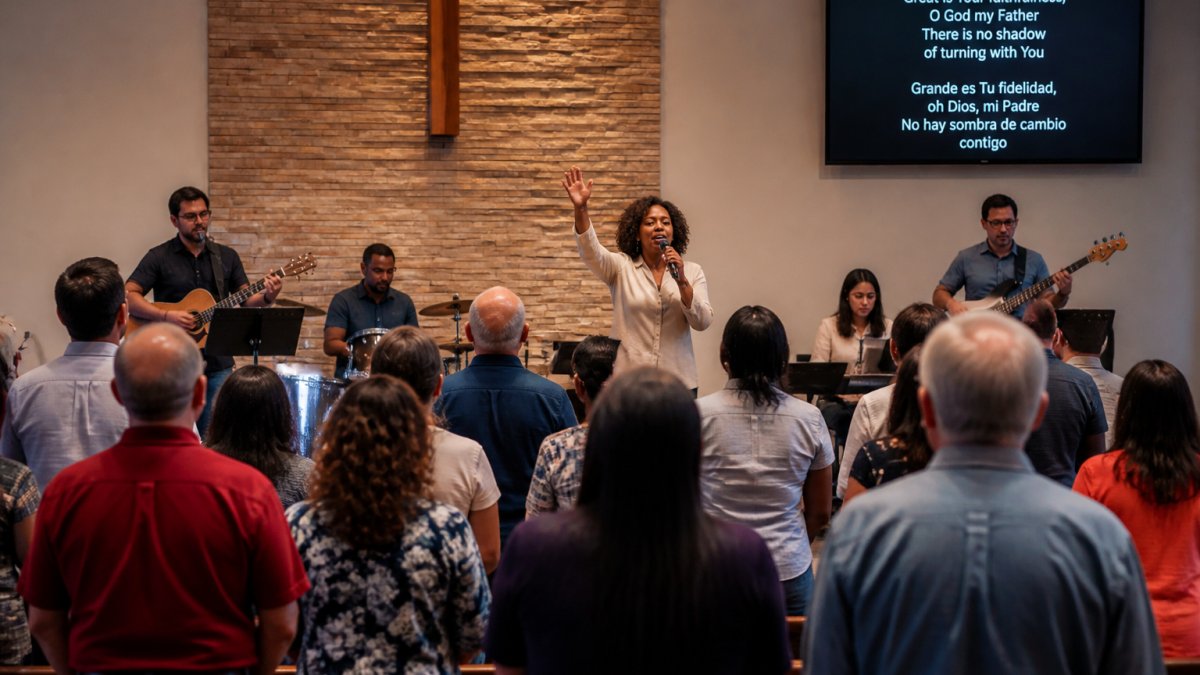
A few practices that hold up across traditions:
- Alternate languages by section, not by sentence, so listeners can follow a full thought
- Give the welcome, the Scripture reading, and the prayer to different language speakers
- Print both languages side by side, never one on the front and one hidden at the back
- Keep announcements short and repeat them in both languages
- Train ushers and greeters to welcome in both languages
For more on keeping a mixed congregation engaged through a full service, see how to boost engagement in multilingual worship.
The mistake we see most often is treating the second language as a special feature. When it becomes part of the ordinary rhythm, people stop bracing for the translation and start singing.
Choosing Church Service Interpretation Tools That Fit Your Room
Church service interpretation tools fall into several families, including live interpreters, translated printed materials, live captions, and AI translation.
Use this table to match the tool to your room and your people:
| Tool | Best For | Watch Out For |
|---|---|---|
| Live interpreter | Sermons, prayers, live give-and-take | Needs a clear audio channel and a prepared volunteer |
| Translated materials | Bulletins, lyrics, liturgy, announcements | Print deadlines; last-minute changes get missed |
| Live captions | Deaf and hard-of-hearing members, low-literacy readers | Screens must be readable from the back row |
| AI translation | Drafts, overflow languages, quick turnaround | Needs human review for theological terms |
A common mistake is buying the tool before defining the need. If your gap is the sermon, invest in interpretation. If your gap is the songs, invest in translated lyrics.
A simple decision path helps. Start with the audit from the first section and ask three questions in order:
- Who is in the room, and what do they need to understand? If the need is the sermon, live interpretation or captions carry the most meaning. If the need is the songs, translated lyrics matter more than a spoken interpreter.
- What can your volunteers sustain week to week? Live interpretation and captions require a trained person and a tech channel every service. Translated materials can be prepared ahead of time but go stale when the service changes.
- What accuracy does the moment require? Prayers, communion words, and Scripture readings carry theological weight that demands human review. Announcements and welcome lines tolerate more flexibility.
Watch out: AI translation can flatten theological language. Words like grace, covenant, and repentance carry weight that a generic engine may soften. Always have a bilingual member review anything projected or printed.
For more on keeping a mixed congregation engaged through a full service, see how to boost engagement in multilingual worship.
The mistake we see most often is treating the second language as a special feature. When it becomes part of the ordinary rhythm, people stop bracing for the translation and start singing.
Worship Song Translation and Adaptation Without Losing the Meaning
Worship song translation and adaptation is the work of carrying a song's meaning into another language while keeping it singable. That means matching the sense of the lyric, the rhythm of the melody, and the breath of the singer. A literal translation that no one can sing has failed, even if every word is correct.
Start with songs your congregation already knows by heart. Familiar melodies lower the barrier for a new language. Then follow a simple review loop:
- Draft the translation with a bilingual member, not a machine alone
- Sing it aloud with a small group and mark awkward phrases
- Check the theological terms with your pastor or a trusted teacher
- Test it with the full congregation and note where people drop out
- Keep a shared file of approved versions for future services
For guidance on choosing songs that travel well across languages and cultures, read worship music for diverse congregations.
What most guides miss is the value of a plain-language version. Sometimes the right move is not a word-for-word translation but a simpler lyric in the same language, so children, new believers, and second-language speakers can all sing the same line.
Multilingual Worship Service Examples You Can Learn From
Multilingual worship service examples tend to follow three patterns: the rotation service, the parallel service, and the shared celebration. Each one teaches something different about bridging linguistic gaps in worship, and each carries its own trade-offs in planning, volunteer load, and congregational buy-in.
- Rotation service: languages take turns leading sections of one service. Simple to start, and it gives every group a visible role. The trade-off is that a visitor who speaks only one language will sit through segments they cannot follow, so keep each segment short and pair it with printed or projected text in both languages.
- Parallel service: the same sermon is preached in two languages, either in one room with interpretation or in two rooms at once. Good for larger congregations. The trade-off is volunteer depth: you need two preachers or a strong interpreter, plus duplicate tech and ushering.
- Shared celebration: a quarterly or seasonal service where every language group leads a song or reading. Builds unity without demanding weekly logistics. The trade-off is that it can feel like a showcase rather than ordinary worship, so anchor it in the same liturgy the congregation uses every week.
A small church with two language groups might start with rotation. A growing congregation with three or more groups often lands on parallel services with a shared celebration a few times a year. The pattern that fits is the one your volunteers can sustain without burning out.
What most guides miss is the value of a plain-language version. Sometimes the right move is not a word-for-word translation but a simpler lyric in the same language, so children, new believers, and second-language speakers can all sing the same line.
Across these patterns, visibility of one's own language on stage can help people feel they belong, while preparation keeps it from feeling like performance. Rehearsing transitions, printing both languages side by side, and training greeters to welcome in both languages are practical steps.
How to Measure Whether Your Inclusion Efforts Are Working
You can measure language inclusion with four simple signals: how many people sing, how many stay after the service, how many volunteer, and how many say they understood. None of these require a research budget.
Try a short, anonymous survey twice a year:
- Did you understand the sermon today? Yes, mostly, or not really
- Did you sing along with the songs? All, some, or none
- Did you feel welcome in your own language? Always, sometimes, or rarely
- What would help you participate more?
Then watch the room. Count how many voices you hear during a song in the second language. Note whether the same families leave early every week. Track whether new volunteers come from every language group.
For a fuller set of measures, see 7 ways to measure success in church worship.
If the numbers stay flat, do not assume the effort failed. Ask whether the effort reached the moments that matter. A translated bulletin helps, but it will not fix a sermon no one can follow.
Building a Team and Plan to Close Linguistic Gaps in Worship
Closing linguistic gaps in worship is a team sport, and the team is bigger than the worship leader.
Here is a simple plan you can start this quarter:
- Name one coordinator for language access
- Recruit two bilingual reviewers for lyrics and printed materials
- Train one tech volunteer on captions and audio channels
- Set a review deadline before every service, not the night before
- Review the audit findings every three months and adjust
For training ideas to equip your volunteers, read worship ministry team training ideas that work.
Let Her Sing! is a call to the church to invite every voice into the life and worship of the congregation, and it treats leadership as service to one another.
Watch out: a plan that lives only with the worship leader will stall the moment that person is away.
Bridging linguistic gaps in worship is not a program you launch and finish. It is a habit of listening, planning, and making room, Sunday after Sunday.
Frequently Asked Questions
How can a church make worship accessible to people who speak different languages?
Start by finding out which languages are actually present in your congregation, then choose the lightest tool that serves them: printed translations, projected lyrics in two languages, live interpretation, or captions. Pair every tool with a volunteer who can check quality and explain unfamiliar terms. The goal is comprehension and participation, not a perfect production. Review what worked after each service and adjust.
Should a multilingual church service translate every song and spoken message?
Not necessarily. Translating everything can overwhelm a congregation and stretch volunteers thin. Prioritize the sermon, the songs the congregation sings most often, and any announcements that require action. For other moments, use visual cues or a short spoken summary. Ask members which parts they most need in their own language, and let their answers set the order of work.
How can worship leaders choose songs that work across language groups?
Look for songs with short, repeatable phrases, clear theological language, and a melody that sits comfortably in a shared range. Introduce one unfamiliar song at a time, explain its meaning in plain language, and sing it several weeks in a row so it takes root. Where a full translation is awkward, a simple refrain in another language can let everyone join the same moment.
What practical tools help people follow a worship service in another language?
Options include printed or digital service sheets, projected bilingual lyrics, live interpreters with a quiet audio channel, captions on a screen, and reviewed AI translation for written materials. Match the tool to the room and the people: interpretation suits spoken teaching, captions help deaf and hard-of-hearing attendees, and translated lyrics support singing. Always have a person review translated text for theological accuracy before it is used.